Triple star system that shouldn't exist found 28 light-years from Earth

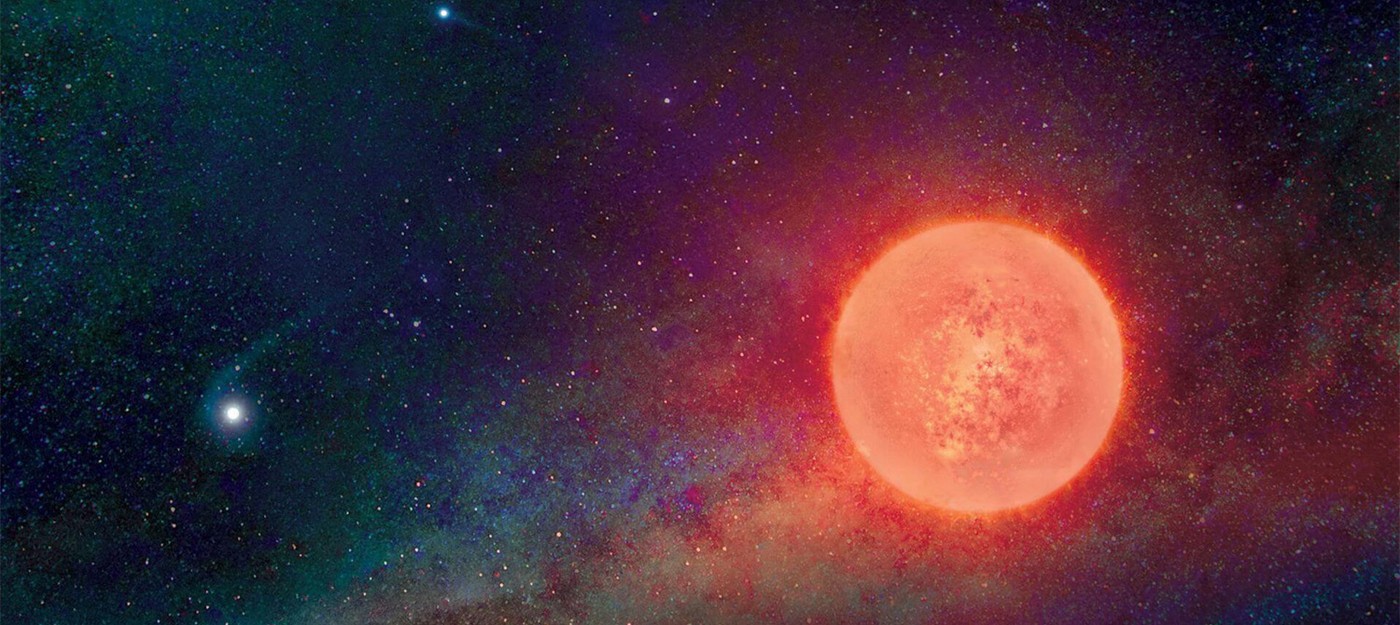
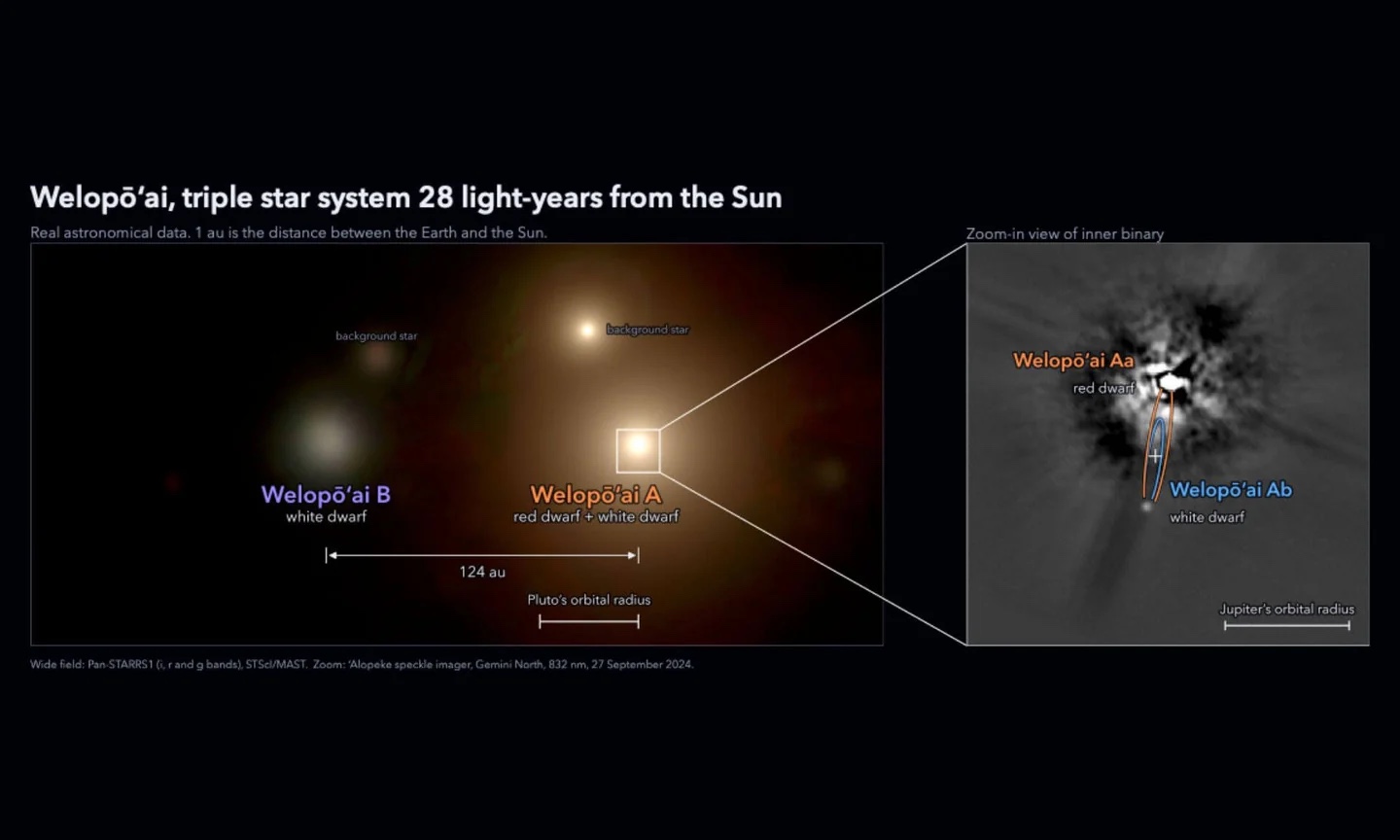
Astronomers have found a star system right next door to the Solar System that doesn't fit current models of stellar evolution. It sits 28 light-years from Earth and is a hierarchical triple: a red dwarf and two white dwarfs. The central pair orbits so tightly that the stars should have merged into one long ago.
The system is named Welopōʻai, which means "path of family traits" in Hawaiian. The results were published in Astronomy and Astrophysics:
This system should not exist. We have no clean explanation for how it got here.
That's how study coauthor Patrick Dufour, an astrophysicist at the University of Montreal, summed up the discovery.
The system turned up by accident during an exoplanet hunt. The team was working with SPIRou, a near-infrared spectrograph on the Canada-France-Hawaii Telescope, which sits atop the dormant Maunakea volcano in Hawaii.
SPIRou is built for precise radial velocity measurements. The method picks up tiny shifts in the lines of a star's spectrum, which appear as the star moves toward and away from the observer under the pull of an unseen companion. It's the usual way to find planets, which tug a star around by a few meters per second.
The red dwarf at the center of Welopōʻai behaved differently. Its velocity swung by nearly 16 kilometers per second, more than a thousand times larger than expected. That pointed to a very massive object on a tight orbit.
It took several years of observations to work out what was going on. The calculations showed that the red dwarf's hidden companion has more than half the mass of the Sun, yet barely gives off any light:
The unusual combination of high mass and very low brightness left only one plausible explanation: it was the remnant of a dead star. The most likely explanation was a white dwarf, although a neutron star or even a black hole couldn't be ruled out.
That's how study coauthor Charles-Antoine Parent, a second-year physics student at Université Laval, recalled this stage of the work. High-resolution images from the 'Alopeke instrument on the Gemini North telescope, also on Maunakea, finally ruled out the exotic options.
The final picture looks like this. Welopōʻai A is a tight pair of a red dwarf and a white dwarf, while a second white dwarf, Welopōʻai B, orbits far away from it.
The distant white dwarf raises no questions. Its sibling in the central pair is what stumps astronomers. A star that ends up as a white dwarf of this mass first expands dramatically, with its outer layers swelling until it becomes a subgiant or giant.
By the authors' calculations, the swollen envelope of the progenitor star should have reached the red dwarf. In such cases, the pair usually ends up inside a common envelope, loses orbital energy, and spirals inward until the two merge:
Strong tidal interactions and at least partial envelope grazing were nearly unavoidable.
That's what the researchers wrote in the study. Yet the stars didn't merge and still orbit each other.
The key to the puzzle may lie with the third member of the system. One early hypothesis holds that the gravity of the distant white dwarf kept the central pair from merging while one of the stars was swelling to giant size.
Testing that isn't easy, since three-body interactions require complex models. The team plans to keep observing and to model the stars' mutual influence more precisely, which should help explain how these aging stars arrived at their current arrangement.
Welopōʻai has almost nothing to be compared with. According to the authors, there is no known analogue of a hierarchical triple with a more distant white dwarf within 100 light-years of Earth.
Coauthor Étienne Artigau, Dufour's colleague at the University of Montreal, believes the system's uniqueness should push astronomers to look more closely for peculiar behavior among other objects in the Sun's neighborhood.
Discoveries like this remind us that our own cosmic neighbourhood still contains remarkable surprises.
Welopōʻai is now one of the most unusual systems among the stars closest to Earth. If the idea of a stabilizing third star holds up, ideas about the evolution of close binary systems will need a rethink.
- Hundreds of thousands of units fight simultaneously in space and on planets in the Horu strategy game trailer
- Object found beyond Neptune orbiting the Sun in the opposite direction
- Hubble sees for the first time in visible light a 150-billion-kilometer "cat's tail" in a neighboring star system