Hubble sees for the first time in visible light a 150-billion-kilometer "cat's tail" in a neighboring star system

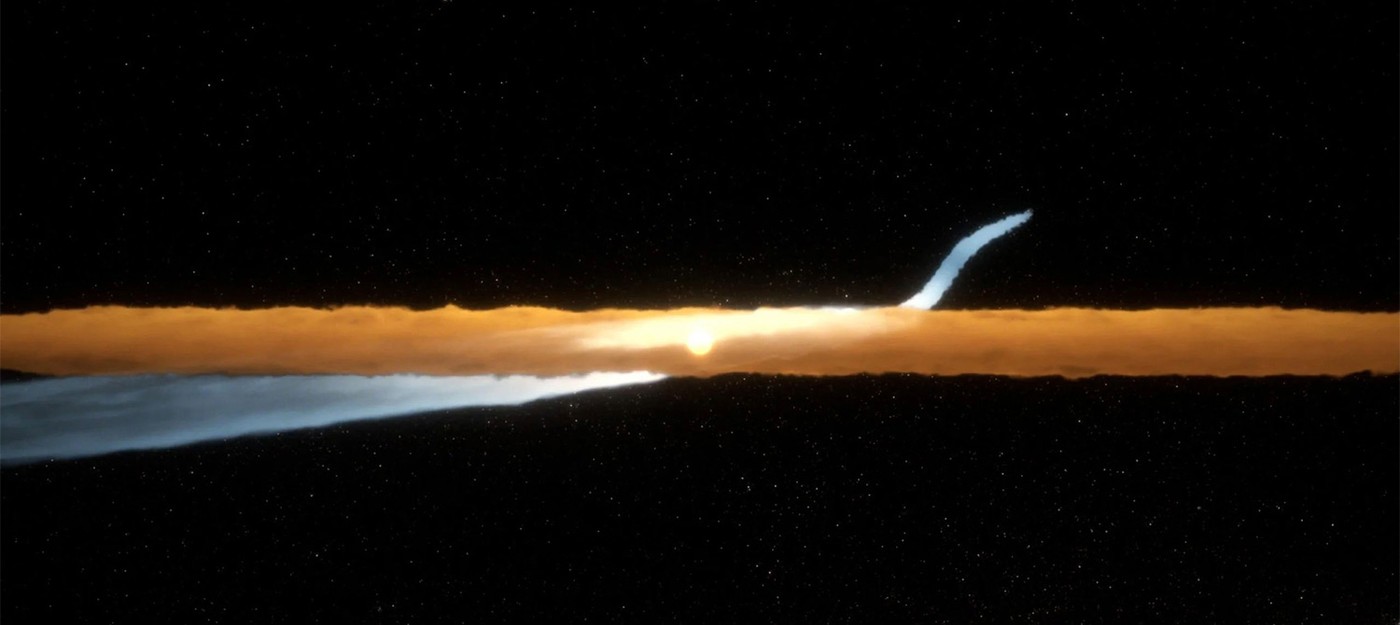
Some 63 light-years from Earth, in the young Beta Pictoris system, sits a huge structure stretching about 1,000 astronomical units, or roughly 150 billion km. Astronomers have nicknamed it the "Cat's Tail."
It appears to consist mostly of dust and juts out from the plane of the giant dust disk surrounding the star. The James Webb Space Telescope was the first to observe it directly, in infrared light.
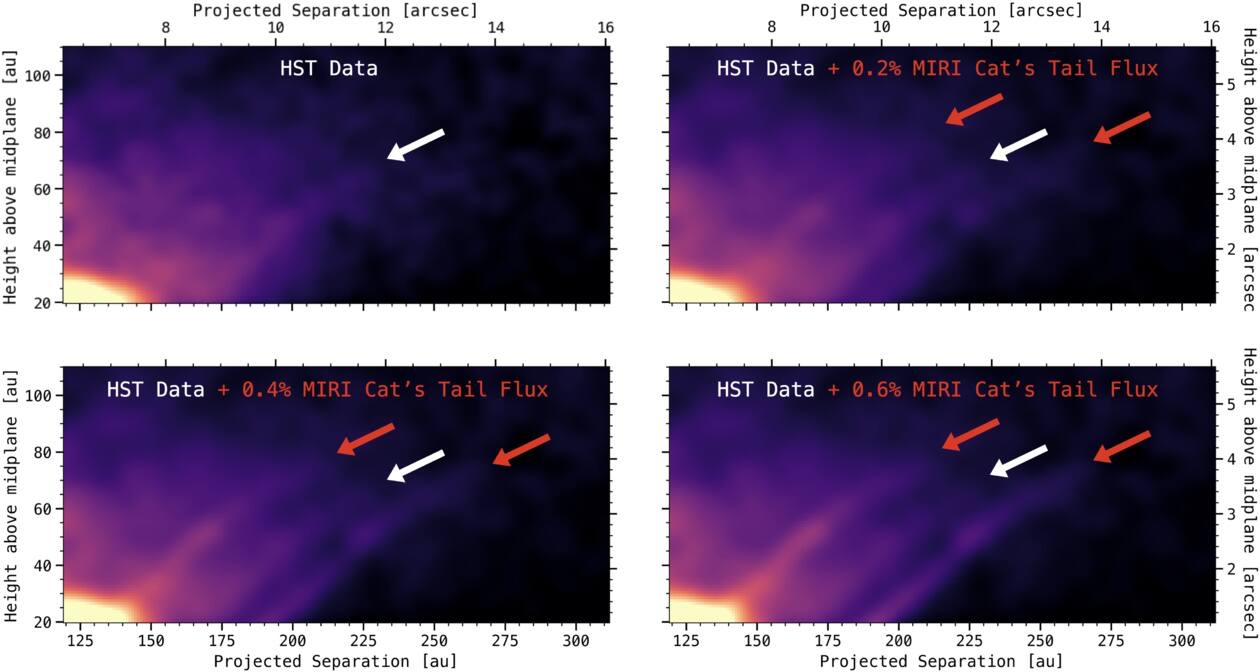
Now the tail has also shown up in visible light, in new images from the Hubble Space Telescope. A team led by University of Arizona scientists published the results in The Astrophysical Journal Letters.
For a long time, nobody knew why the structure didn't show up at shorter wavelengths. Researchers think the answer lies in its composition.
Arin Avsar, graduate student at the University of Arizona and lead author of the study:
It's odd, but until now only the James Webb Space Telescope, which detects infrared radiation, had seen this structure. At shorter wavelengths it stayed invisible, which has puzzled the scientific community for a long time. We think the Cat's Tail has evaded visible-light observations until now because of what it's made of.
According to Avsar, the tail is made almost entirely of so-called organic refractory material, which is rich in carbon. Long chains of carbon atoms absorb visible light, which makes the material extremely dark.
Scientists believe the Cat's Tail formed after collisions between large Pluto-sized bodies, which scattered enormous amounts of dust across vast distances. The heat released by the impacts may have been enough to vaporize carbon, which then cooled and condensed into loose, porous dust grains.
By comparing infrared images with visible-light ones, the researchers calculated the three-dimensional geometry of the structure. The result was unexpected:
We found that instead of stretching 1,000 astronomical units behind the star, the Cat's Tail may actually extend sideways relative to us, with no depth at all. Essentially, it lies in the same plane of the sky as the star and may pass slightly behind it.
The team also spotted a strange warp in the dust halo enveloping Beta Pictoris. Scientists link it to at least three known planets in the system, whose gravity has a noticeable effect.
- Object found beyond Neptune orbiting the Sun in the opposite direction
- No Man's Sky players built a memorial to Patrick Stewart and held a mass farewell to the legendary actor
- On November 18, Voyager 1 will become the first human-made spacecraft to move one light-day away from Earth