The artist who turned Whiterun into a city of 15,000 residents has drawn Oblivion's Imperial City for 1.5 million people

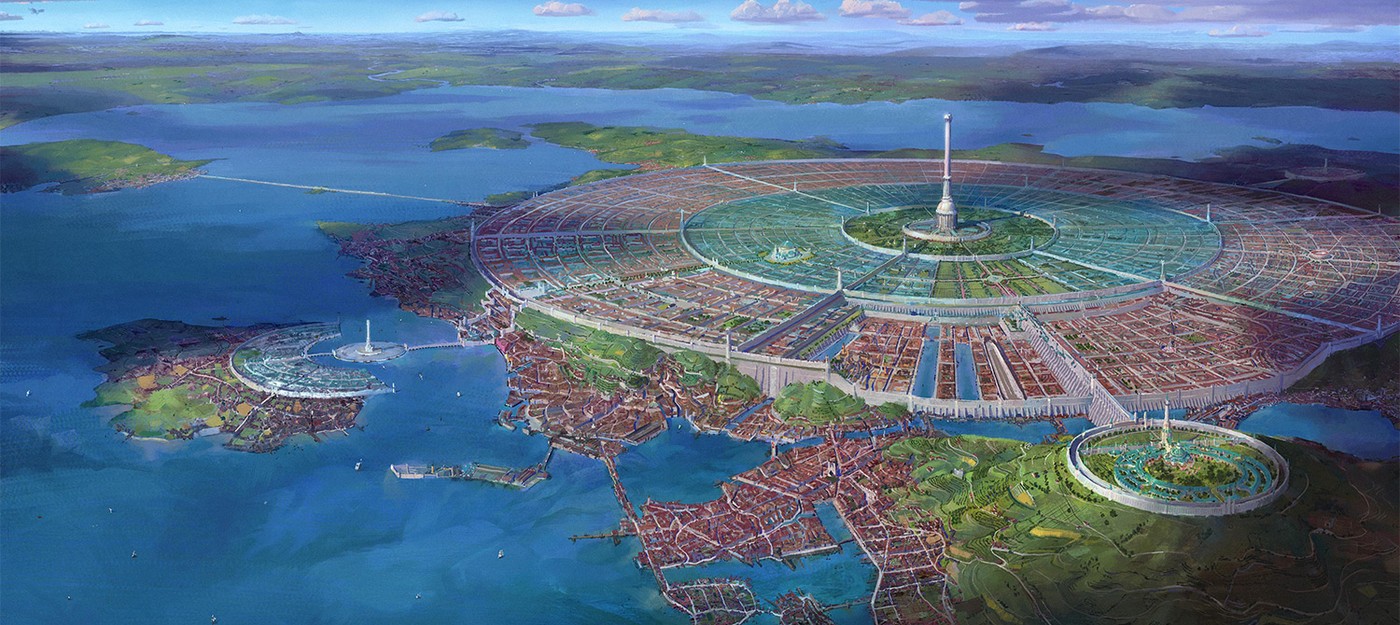
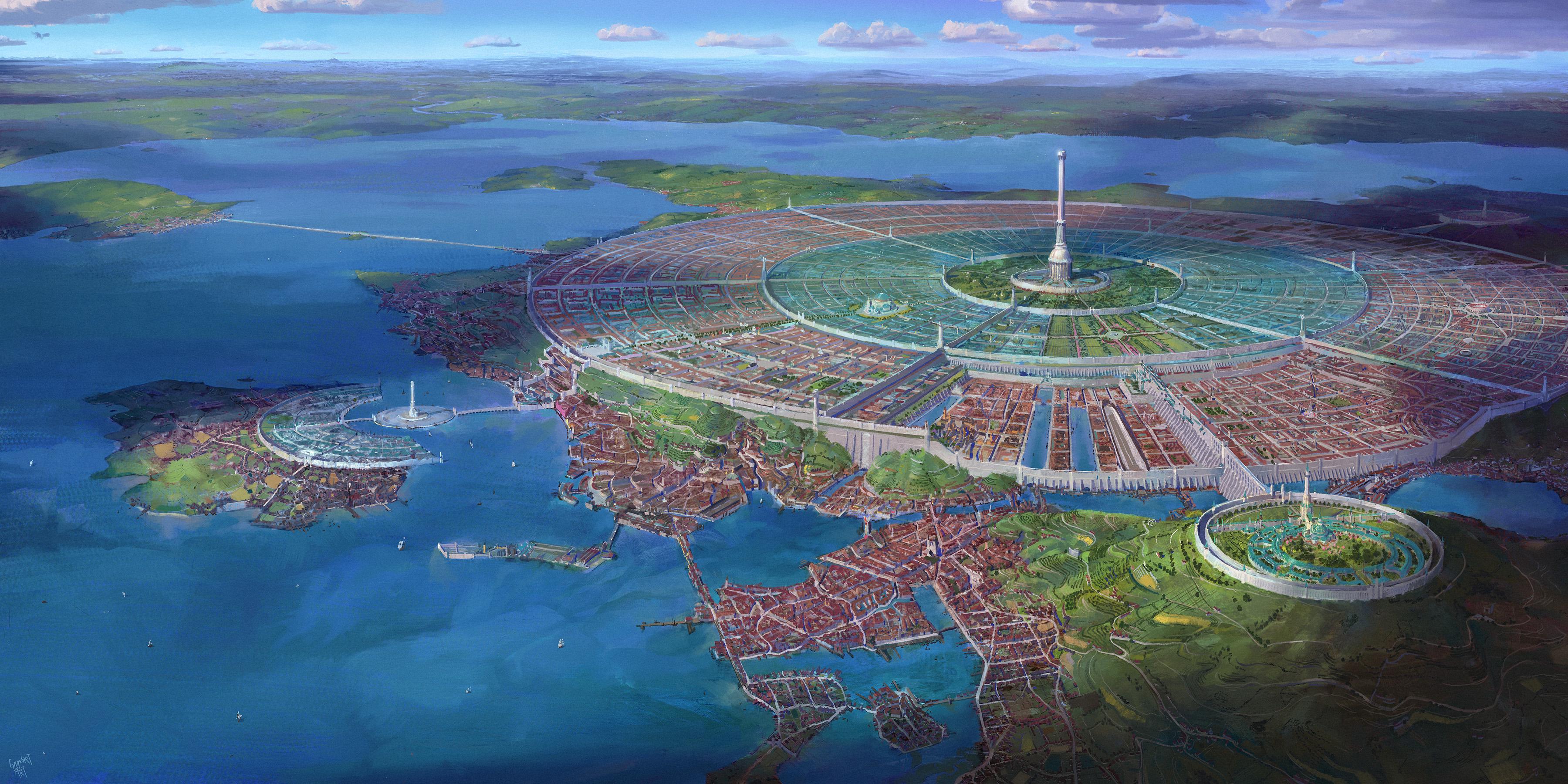
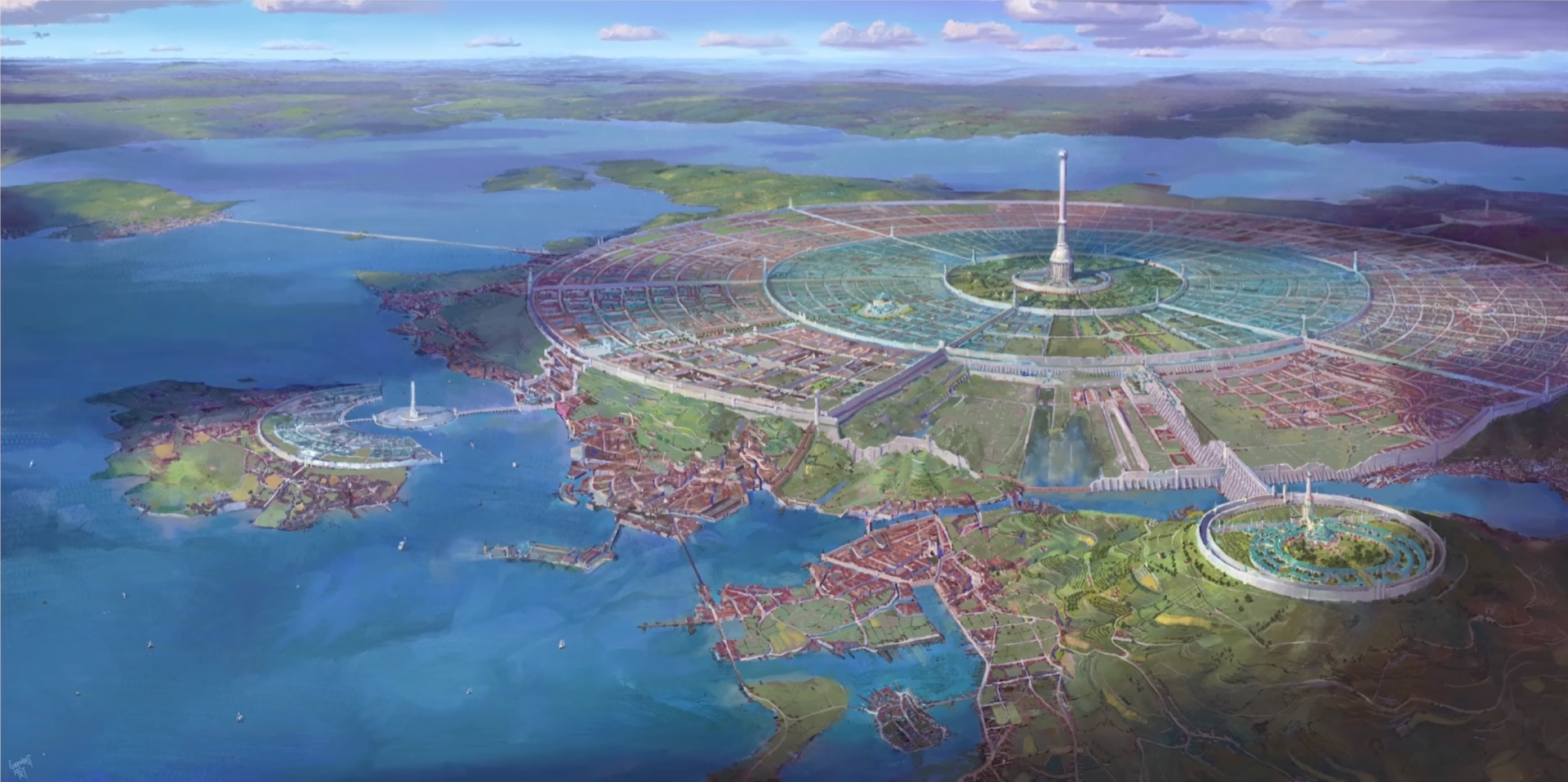
Illustrator Cormac Ganshirt, known as cormeals, previously recreated Whiterun, Solitude, and Markarth from Skyrim at realistic scale. Now he has taken on the largest city in The Elder Scrolls universe – the Imperial City from The Elder Scrolls IV: Oblivion.
According to the artist, something is always lost when a world moves from one medium to another, and Oblivion ran into exactly that problem in 2006.
Before the game came out, lore described Cyrodiil as a lush jungle with varied architecture, and the Imperial City as a subtropical archipelago metropolis, with districts built on glittering bridges over rivers and a lake stained red by silt.
Players ended up with medieval lands and a round city on a single island, or two if the port counts. Ganshirt attributes this to the hardware limits of the time, which made dense vegetation hard to render, and to the studio caution after the risky Morrowind. He admitted the decision worked, though, and Oblivion remains a classic he has spent many hours in.
cormeals started with Skyrim, so the Disneyland-style medieval main street always felt anachronistic to him, both for the serious tone of the series and for the lore. Still, he did not fully return to the descriptions from old books. The artist kept the recognizable round shape of the city and a moderate European climate. He takes traveler accounts with a grain of salt – like medieval chronicles such as the writings of Marco Polo, they were almost certainly exaggerating the grandeur and exoticism.
The first reference point was the Round City of Baghdad, built starting in 762 as the capital of the Abbasid Caliphate. Its concentric walls with a palace at the center reflected Caliph al-Mansur idea that a ruler should be equidistant from everything. Almost nothing of the Round City survives, however, and the circular part itself, just over a mile in diameter, quickly became a small district of the sprawling capital.
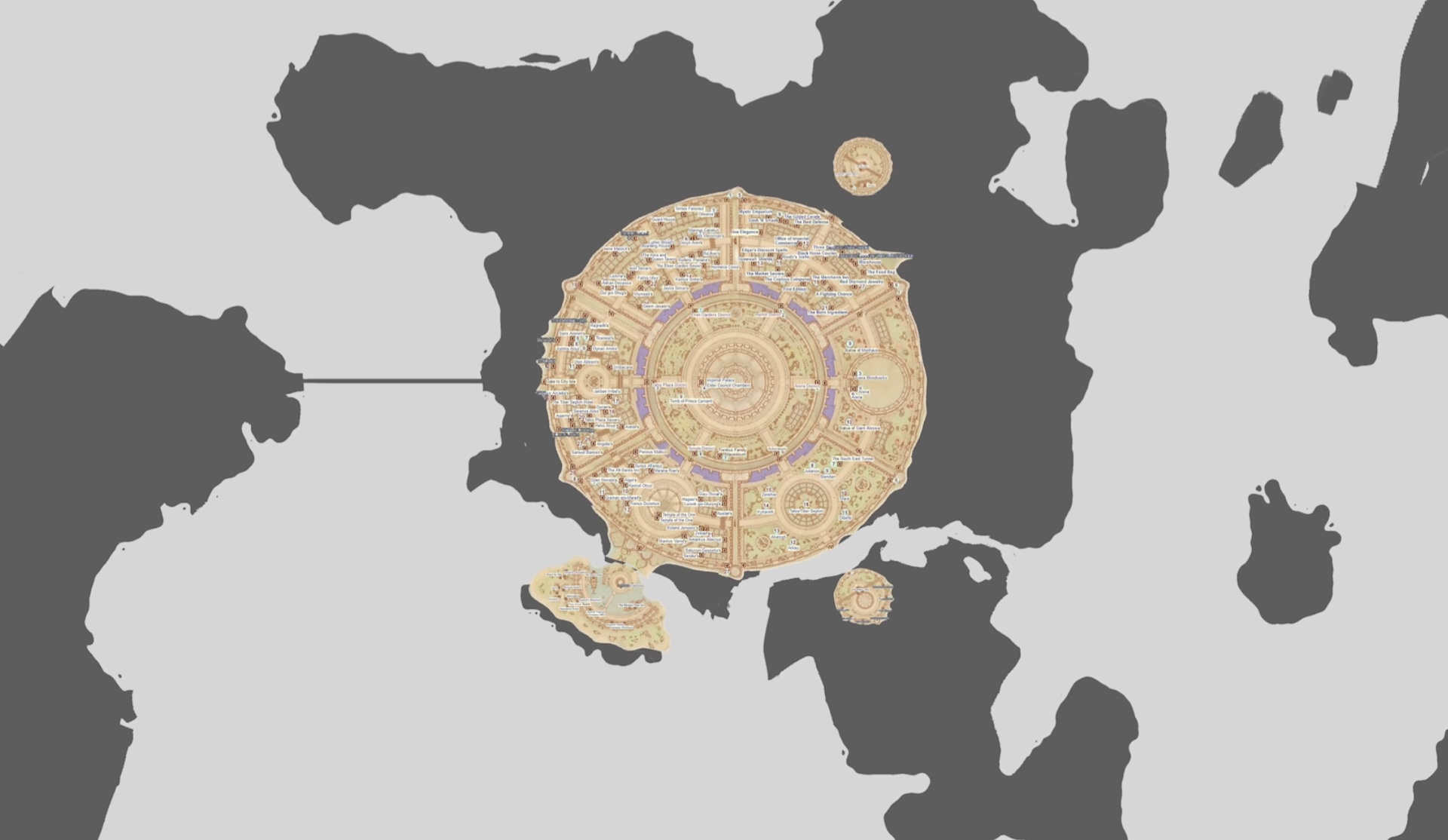
Next came the question of proportions. If the continent of Tamriel is slightly larger than Europe, the island holding the Imperial City would be about the size of Ireland on continental maps. Ganshirt scaled Lake Rumare down in proportion to the continent but kept it large relative to the city, and he split the southern part of the island off into a separate island that holds much of the development outside the walls.
The artist set a target population by analogy with real history. Cities of the past rarely exceeded a million residents, so he settled on roughly 1.5 million for the capital of an empire.
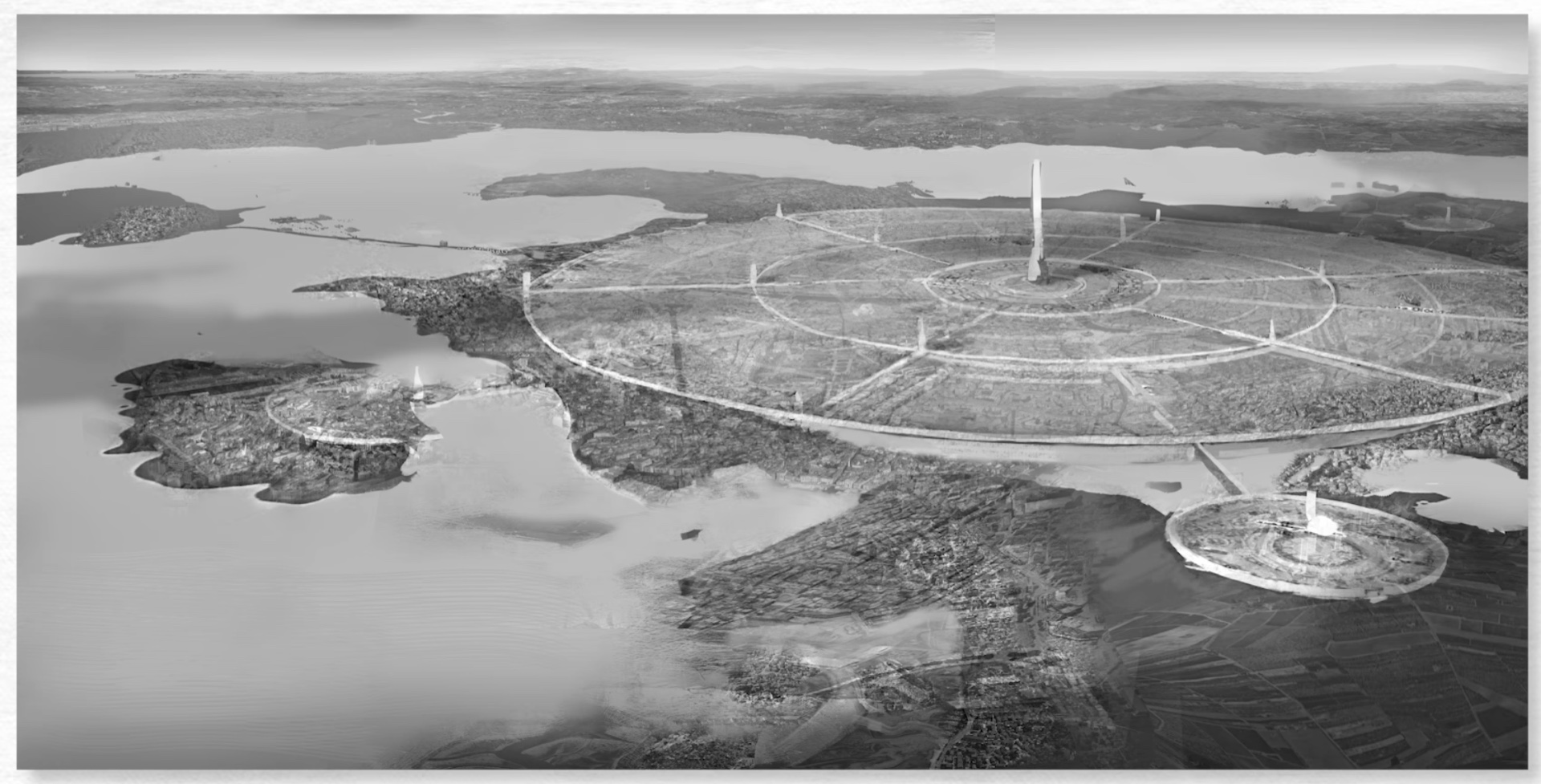
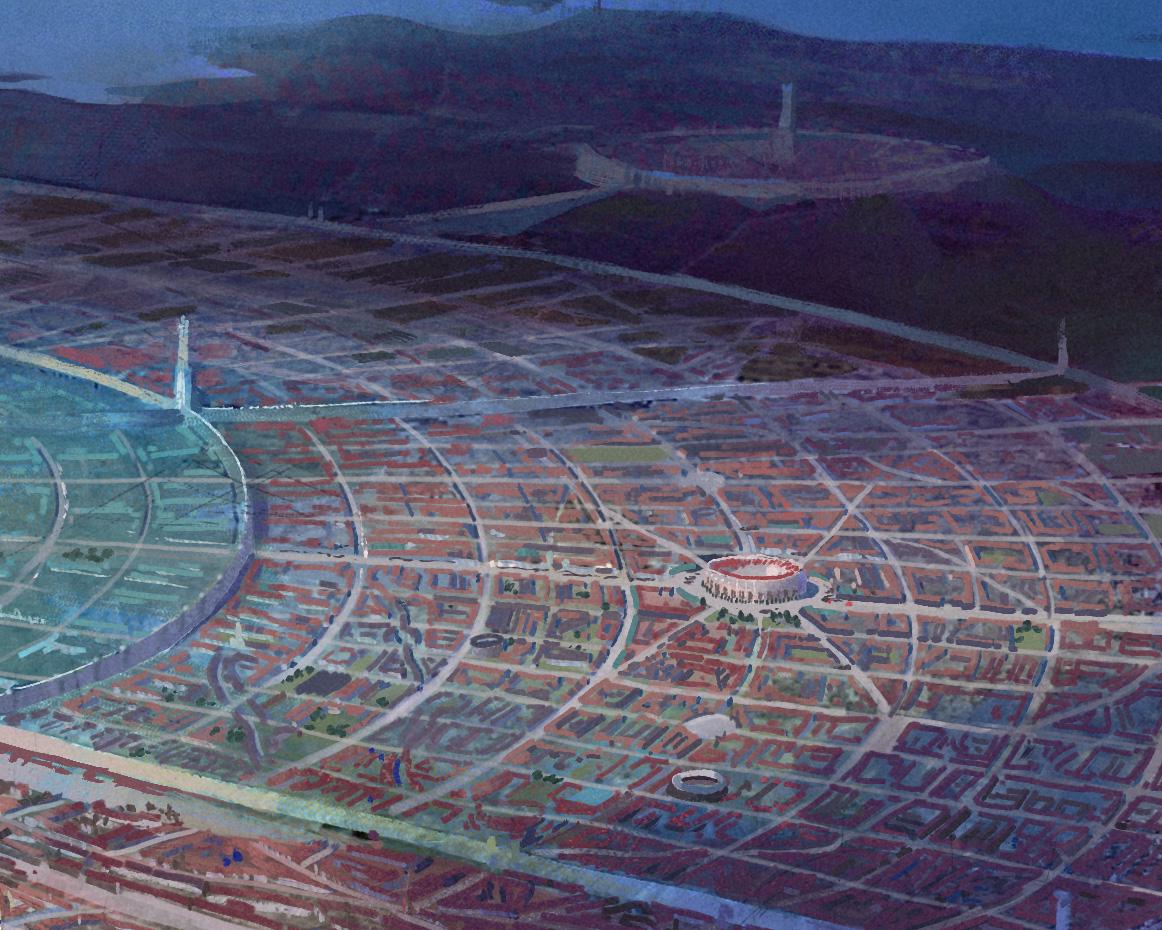
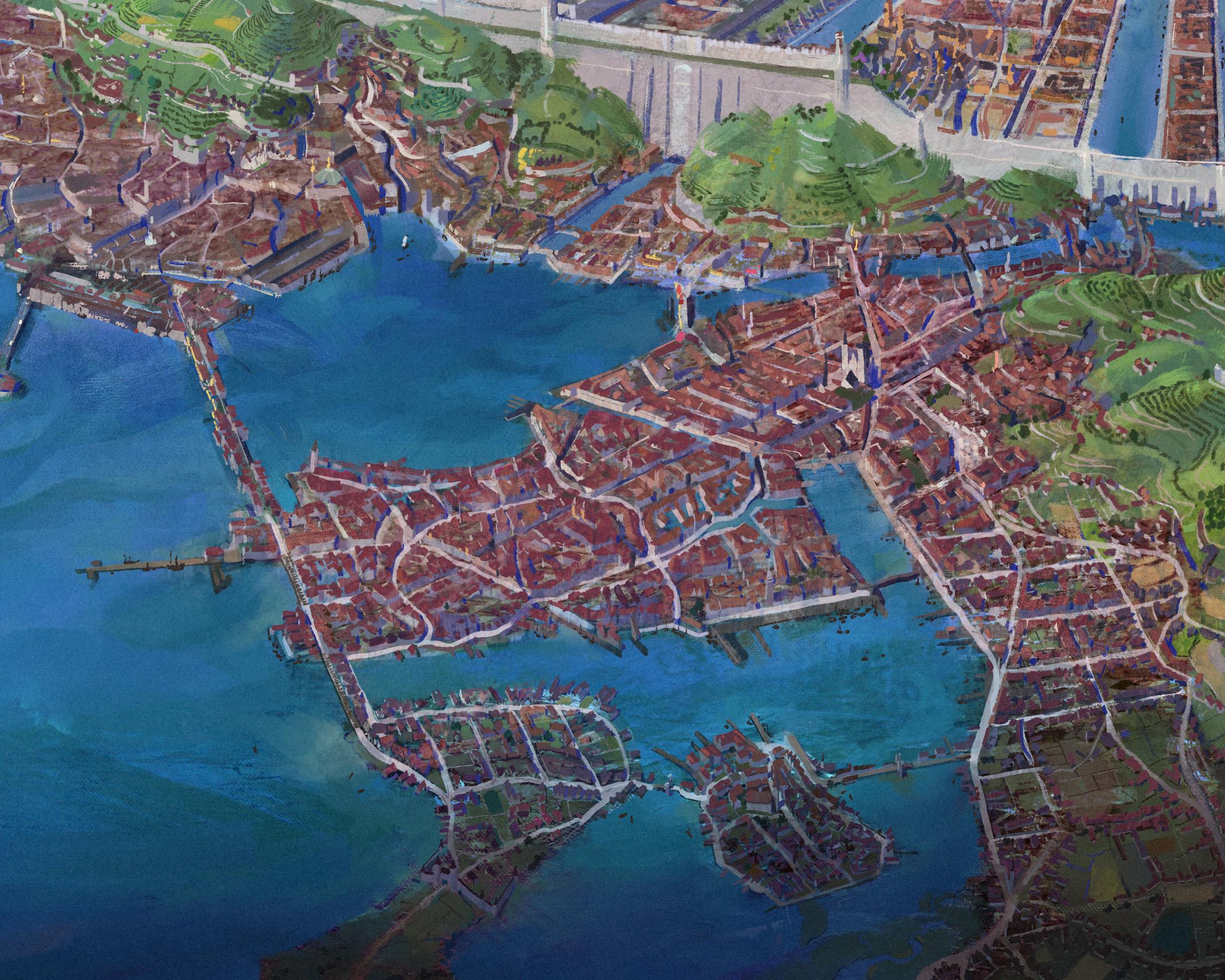
The main model was Constantinople, the largest city of medieval Europe. At its peak, about 500,000 people lived inside the Theodosian Walls, and farmland covered a large share of the outskirts. cormeals housed the rest of the population in suburbs beyond the walls.
The choice was no accident story-wise, either. The painting shows the city in the time of Oblivion, an era of peace and prosperity on the brink of crisis. Like Constantinople after its peak in the 6th century, the Imperial City faces siege, sacking, and a rapid drop in population.
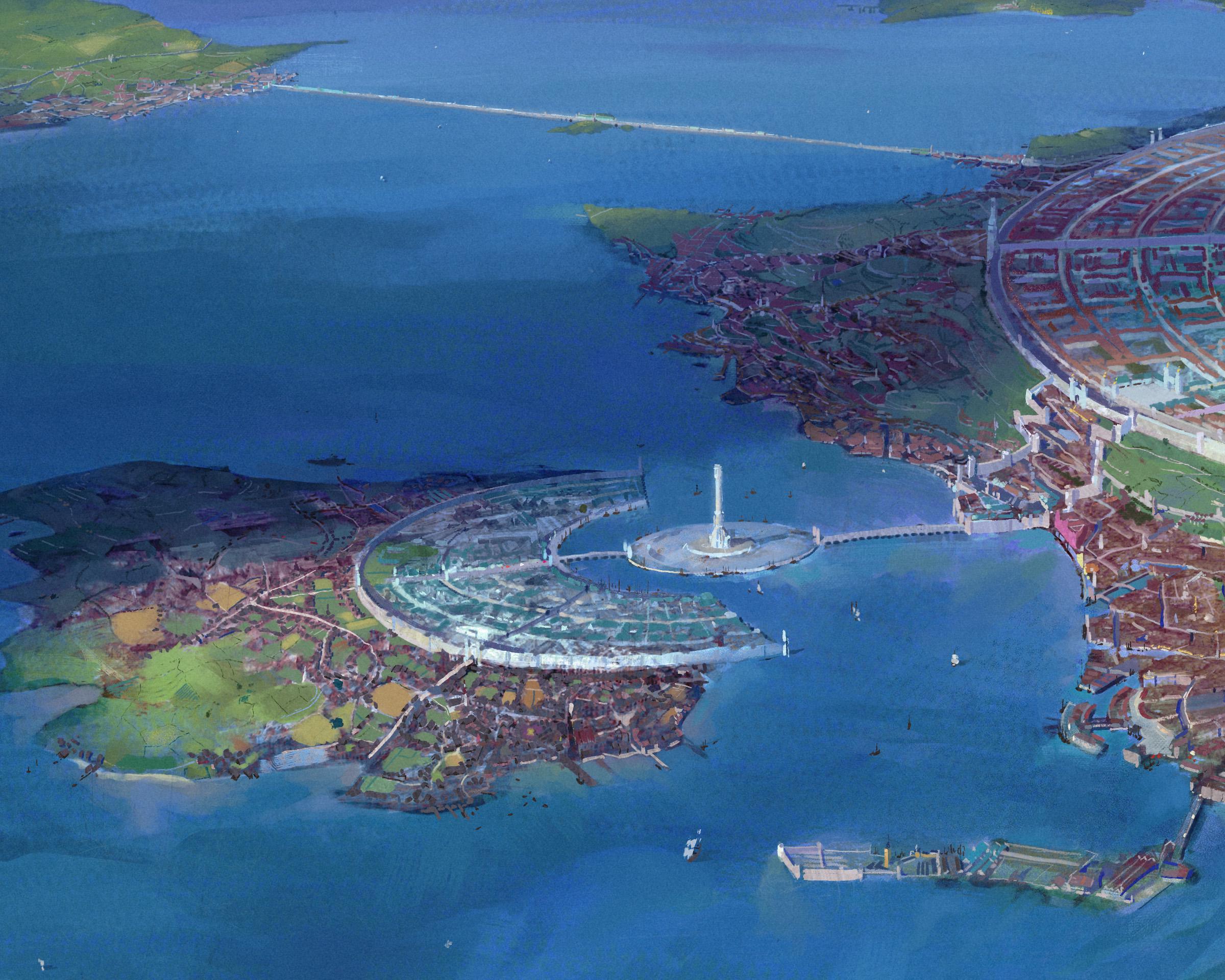
The camera angle was a compromise. From higher viewpoints the city looked tiny, while closer ones cut off important parts like the Arena. The Arcane University and the port ended up in the foreground, and the artist was able to experiment with new districts between them.
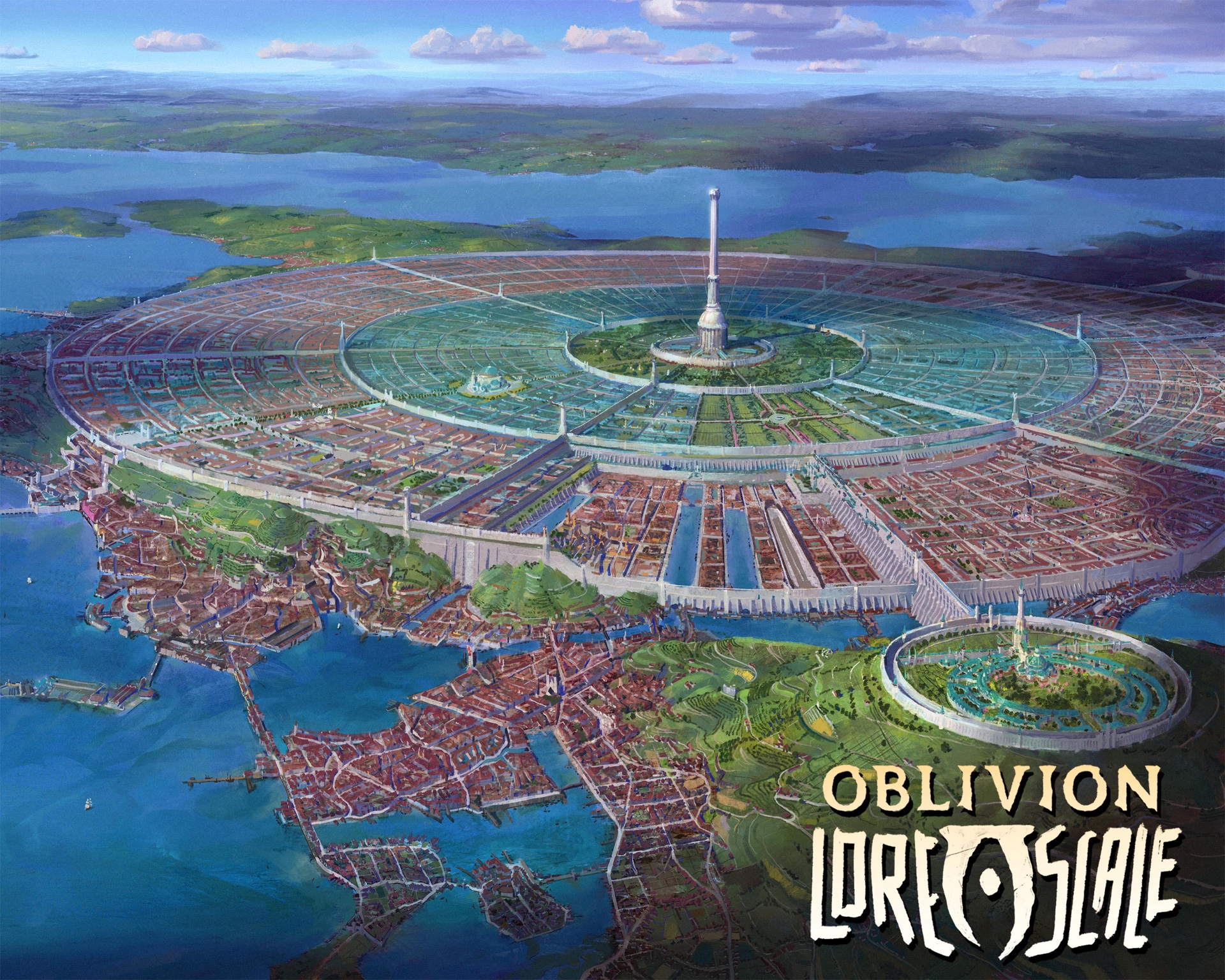
As in his earlier works, the base came from Google Earth imagery. Real building models helped keep the scale: the Golden Gate of Constantinople set the height of the walls, and Bulgaria is visible in the corner of the frame. On top of that, Ganshirt layered textures from Mediterranean and North African cities, and he moved the Arcane University onto a hill above the lake.
The artist called cloud shadows a cheat code that visually expands space. He wanted the new painting to look brighter and more idyllic than the previous ones.
cormeals also worked out the history of the city. It was built by the Ayleids, ancient elves whose economy relied on the slave labor of humans, and humans later settled the ruins, restoring and expanding them. In the artist concept, the original Ayleid city was noticeably smaller, and the prison, university, and port appeared later.
The original harbor silted up over time because of a narrow strait and deposits from the lake and rivers. The model was an ancient Roman port that land swallowed completely. New Venice-style districts grew on lowlands, salt flats, and marshes, and some of the old bays were filled in – one of them became a hippodrome that, by the artist calculations, is roughly 60 meters longer than the one in Constantinople.
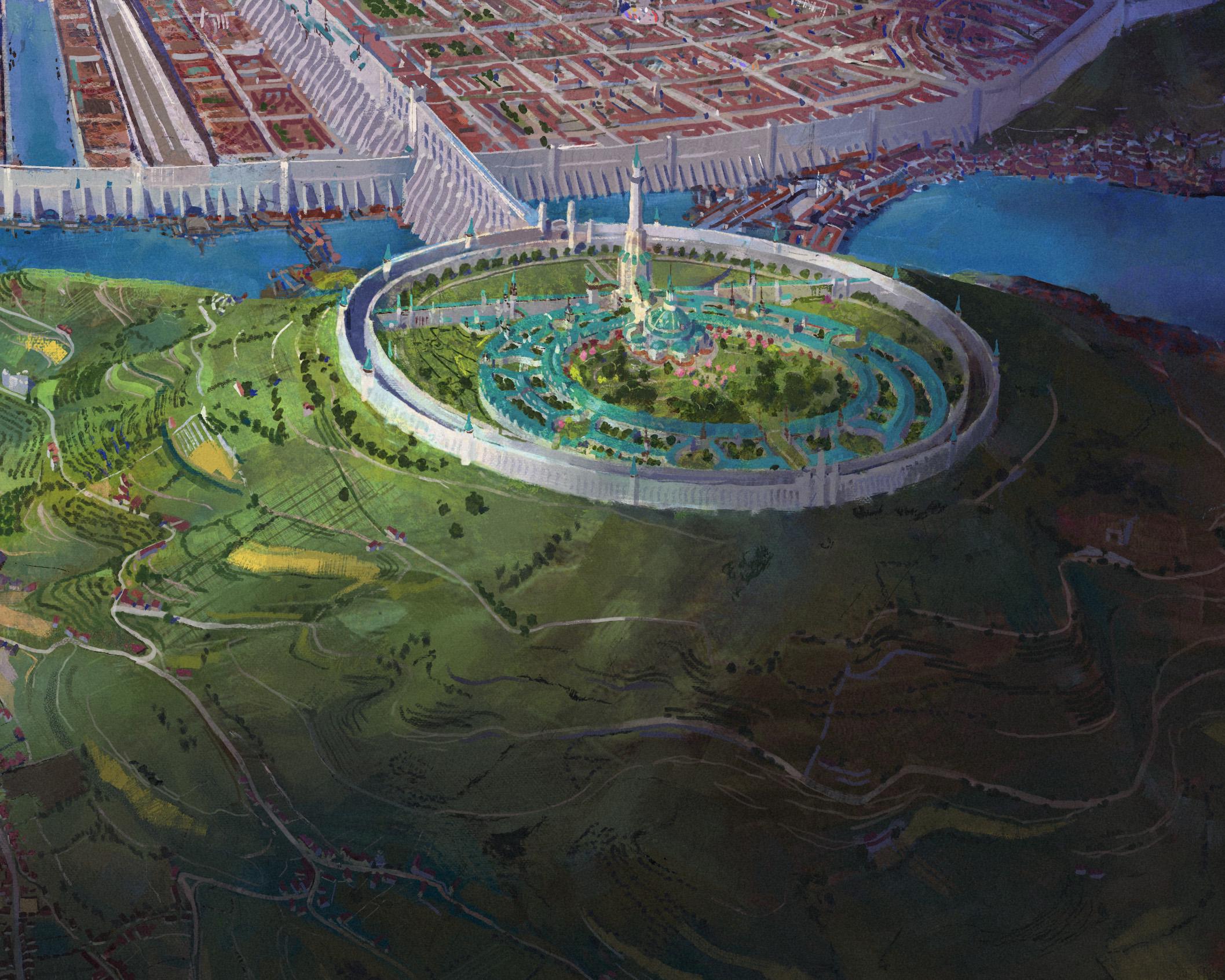
Ganshirt explained the uneven street grid near the hill as a result of human ambition. In his version, human empires suffered from a kind of inferiority complex before the grandeur of the White-Gold Tower and planned to level the hill entirely to expand the port, but that proved too expensive and technically unachievable.
The drawing process repeated his previous works. First the artist blocked in roofs in bright red, where each roof at this scale means a building of at least three stories, then picked out stone color, sunlit and shaded sides, gables, and shadows at block corners. Small decisions about development near the walls and the size of lawns and villages took a full week, and at the request of one of his patrons, an Imperial guard appeared in the piece as well.
Ganshirt admitted he seriously considered setting the painting in 4E 201, the time of Skyrim. Twenty-six years earlier, the Aldmeri Dominion had besieged and sacked the city, and the artist was interested in showing decline modeled on Rome, whose population fell from over a million to fewer than 20,000.
He dropped the idea because too much of the city would have turned into wasteland, and the result could have disappointed Oblivion fans. Still, at the end of the video the artist showed a quick sketch of how a decayed Imperial City might look.
Prints of the illustration are available on the artist page on Etsy, while early versions of the works are posted on Patreon.
Ganshirt asked viewers whether they pictured the city as bigger or smaller, and according to the video description, his next target may be Dishonored.
- Someone has posted 1.4 million free 16x16 pixel sprites, all created by AI
- Former Skyblivion developer threatens colleagues with 30,000 euro lawsuit
- Fan uses Claude AI to speed up Oblivion Remastered by over 40% and almost eliminate stutters