Detector in an abandoned gold mine caught an event that no known physics can explain


Deep beneath the Black Hills of South Dakota, nearly a mile underground, physicists have spent years waiting for a collision that could reveal dark matter. This substance accounts for roughly 85% of the universe's mass and acts as the invisible scaffolding that keeps galaxies from flying apart.
The team behind the LUX-ZEPLIN (LZ) experiment has recorded a single particle interaction that can't be explained by any known background source from ordinary matter. The event is described in a preprint accepted for publication in Physical Review Letters, and it currently stands as the most compelling candidate for a direct dark matter detection to date.
Still, the researchers themselves are urging caution. One event doesn't make for solid statistics, and there could be more than one explanation for it.
Rick Gaitskell, a professor of physics at Brown University and spokesperson for LZ, said in a statement:
We're very intrigued to see this event in the data, in the region where we expect dark matter to show up, and the competing backgrounds are very low. With only one event, we don't want to get ahead of ourselves. We are not claiming to have seen dark matter. But we have seen something interesting that we want to share with the scientific community for their input.
The dark matter hypothesis exists because visible matter alone can't account for certain gravitational effects we observe. Galaxies rotate far faster than their visible mass would allow, and they hold together more tightly than they should. This hidden mass has become a core pillar of the standard model of cosmology.
Dark matter particles don't absorb, reflect, or emit light – otherwise astronomers would have spotted them long ago. Figuring out what this substance is actually made of requires a direct detection, and the search has been compared to looking for a needle in a haystack.
One of the leading candidates for such a particle is the WIMP, or weakly interacting massive particle. According to theory, it responds to gravity, ignores light, and only very rarely collides with ordinary matter.

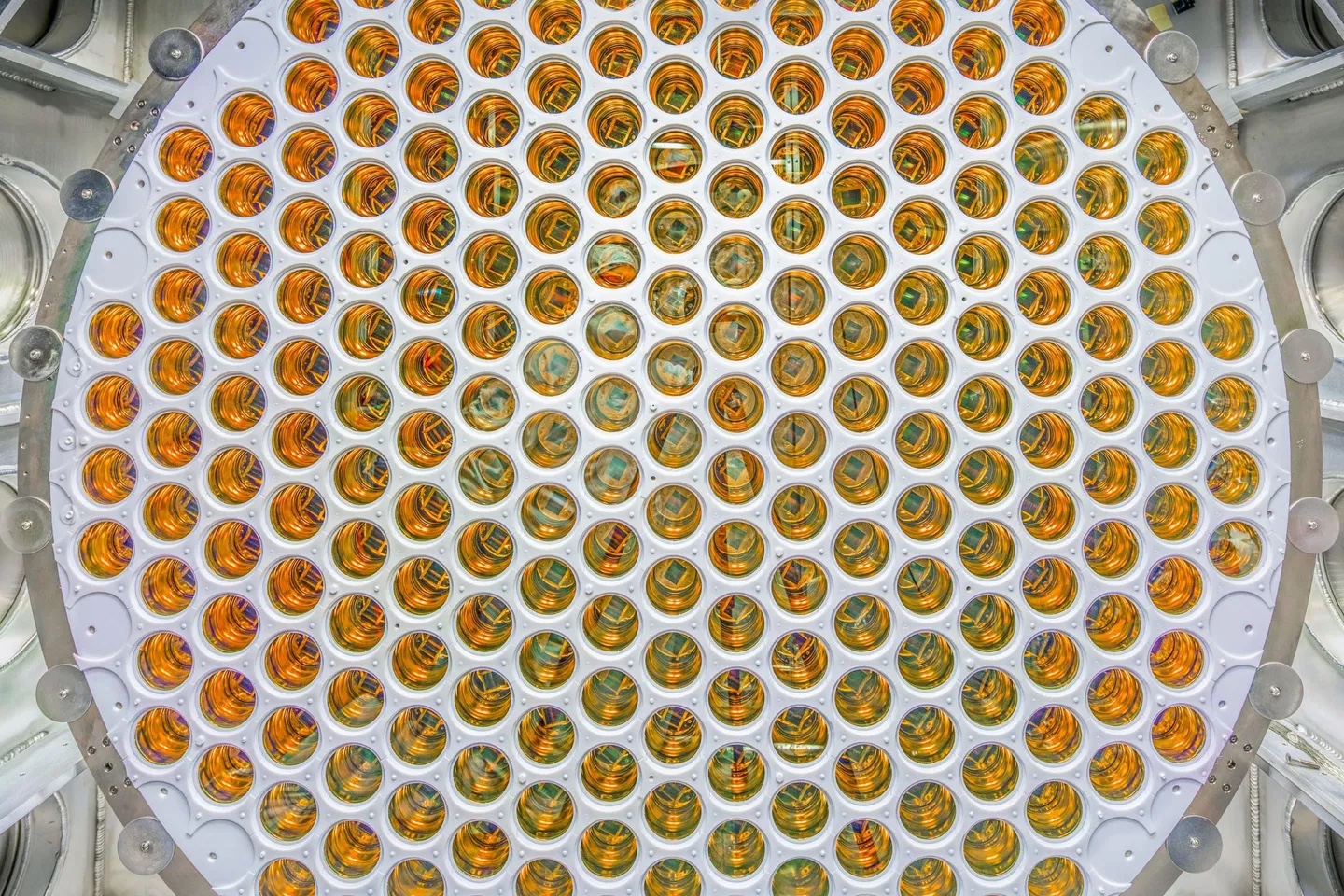
The LZ detector was built specifically to hunt for WIMPs. It's a tank holding 10 tons of ultra-pure liquid xenon, wrapped in sensors designed to catch the flash from a particle striking a xenon nucleus. The setup runs at the Sanford Underground Research Facility (SURF) in Lead, South Dakota, where the surrounding rock shields it from cosmic radiation and other background noise.
For the new study, physicists combed through 220 days of observations collected between March 2023 and April 2024. This dataset had already been searched for faint signals from the simplest WIMP interactions, but this time the team widened the search to cover processes that leave more energy behind in the detector.
Sam Eriksen, lead author of the study and a senior research associate at the University of Bristol, said:
This was a detailed study in a region we hadn't explored within this dataset, and we spent months of additional effort to understand all the possible causes of background events.
The event itself was recorded on June 16, 2023. If it really did come from a collision between dark matter and xenon, the particle responsible would have to be about 200 times heavier than a proton, and the collision itself looks unusually energetic.
This is where a mystery within a mystery begins. Standard theories suggest that before catching one high-energy event like this, the detector should have already picked up plenty of lower-energy ones. It hasn't.
A few explanations are on the table:
WIMPs interact with ordinary matter differently than current models predict
this particular particle picked up an unusual boost in speed, causing it to hit harder than normal
the signal has nothing to do with WIMPs and instead came from some other unidentified particle or physical process
The LZ team has plenty to work with going forward. The experiment has already built up the largest dark matter dataset in the world, and it keeps growing.
If future analyses turn up more events like the one from June, competing detectors – PandaX in China and XENONnT in Italy – will be able to check the results. As Scientific American notes, independent confirmation from these experiments would be the deciding factor in proving that LZ is truly seeing WIMPs.