Users like that Valve remains a company that highlights dislikes while Google hides them on YouTube

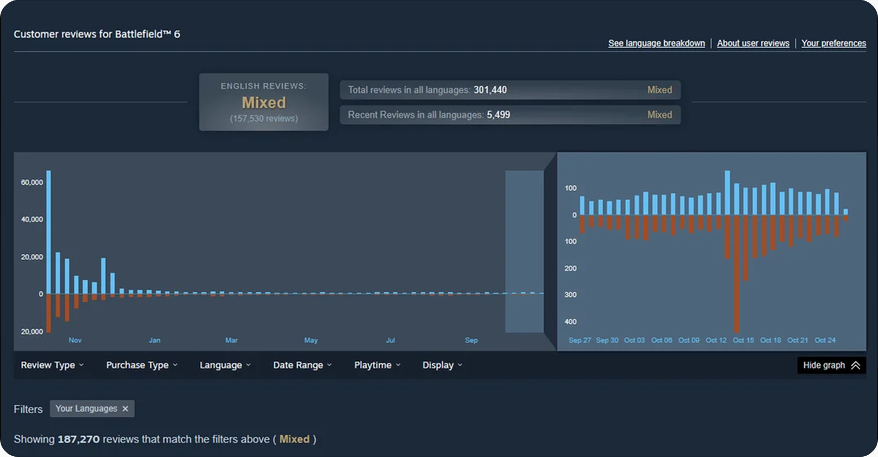
The Steam review histogram is one of the most underrated tools Valve has built. It shows how a game handled its launch and every major patch, and it also pinpoints the day an angry crowd descended on it.
Next to that, YouTube, which hid its dislike counter back in 2021, looks like a platform embarrassed by its own stats. Rumors about removing the button entirely keep popping up online, though nobody has confirmed them officially.
YouTube hid public dislikes in November 2021. The official reason sounded noble: protecting smaller creators from targeted attacks. The number itself never went away and is still available to channel owners in YouTube Studio analytics. Skeptics like to point out that the most disliked video in the history of the platform was its own YouTube Rewind 2018.
Viewers of tutorials and guides suffer most without the counter, since 988 likes can easily sit next to ten thousand invisible dislikes. One viewer put it this way:
Nothing like sitting through a 15-minute fix only to scroll down and find out step 3 completely bricked everyone's install.
Steam went the opposite way. Valve added the review histogram in 2019 as a response to review bombing, and the system learned to flag abnormal spikes as "off-topic" and exclude them from the overall score. There was no shortage of reasons: Helldivers 2 got flooded with negative reviews in May 2024 over the PSN account requirement, GTA 5 took a hit in 2017 after Take-Two cracked down on mods, and Paradox games have repeatedly suffered over decisions that concerned a completely different title from the publisher.
When a buyer spots a sharp red spike on the graph, they can dig into what happened that day and decide whether it matters to them personally.
The system is still far from perfect. The rating is binary with no neutral option, and five negative reviews in a row can drag the Recent Reviews section from "Very Positive" down to "Mixed" and scare people away from a perfectly fine game. On the flip side, there are plenty of "positive" reviews along the lines of "nothing really works, but i give thumbs up because game have potential".
Languages are a story of their own. Chinese players en masse downvoted Hollow Knight: Silksong over weak localization, while Slay the Spire 2 in early access got a wave of negativity from players who use reviews as a line to the developers, bypassing the in-game feedback form. Steam now calculates the rating by default from reviews in the user language.
The gap between the platforms shows in the voting mechanics too. A dislike on YouTube is anonymous and free, and it can be left without even playing the video. A Steam review requires owning the game, is published under a username, and shows hours played.
Valve also has a direct deal with a player who pays money and gets a game, while YouTube makes its money from advertisers. Someone summed it up in a nutshell:
Youtube is a platform for advertisers, and we are the product. Steam is a platform for users, and the game is the product.
On Steam, discontent can be read off a graph down to the day, while on YouTube you can only guess at it from a clickbait thumbnail.