Publisher pulled game from Steam library 13 years after activation


A digital library creates a pleasant illusion of ownership. You buy a game, activate it, and it sits on a virtual shelf for as long as the account lives. The illusion holds right up until Steam says the license was "recently" revoked, while the activation date reads 2013.
That is exactly the screenshot one player posted on Reddit, with the terse caption "What do you mean by recent?" The key was most likely bought from a grey-market reseller, meaning a platform where third-party sellers trade keys instead of the publisher or official stores.
The scheme is a familiar one. A seller buys keys with a stolen card, the card owner spots the charges and files a chargeback, and the publisher gets hit with a fine plus the lost money, then cancels the whole batch.
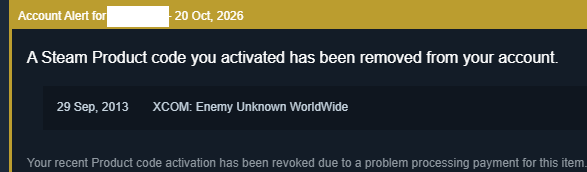
From there, Valve asks the publisher what to do with copies that were already activated, and the publisher can either leave them alone or pull them. Steamworks rules forbid developers from revoking keys from legitimate customers, but that protection doesn't cover fraudulently obtained keys, and there is no statute of limitations.
One theory sounds plausible enough: the grey seller was finally caught and convicted, and a database of keys covering all the years of the operation ended up in the case files. One player couldn't help commenting:
Even the IRS doesn't give a shit after that long
There is precedent, and not only from the grey market. A couple of years ago, Daedalic revoked Deponia keys from boxed editions sold in Poland between 2012 and 2016. Distributor CDP.pl went bankrupt, its warehouse stock reportedly went under the hammer, and keys from the boxes surfaced in resale without the publisher's consent. The whole batch was blocked, catching buyers who had activated the game long before the bankruptcy.
Many got access back only after posting photos of their boxes. Paradox, according to players, periodically purges Crusader Kings 3 keys sold through unapproved resellers.
Official stores don't offer a full guarantee either. Keys from Fanatical and Green Man Gaming sometimes drop off accounts when developers resync codes to weed out ones that leaked to the grey market. Access is usually restored through the seller, though at least one player lost an Age of Empires 4 copy bought there for good. Humble Bundle, which IGN acquired in 2017, has a different kind of problem: keys from the Humble Choice subscription sometimes just run out. Some buyers wait months for a restock, and enthusiasts even set up a dedicated GitHub tracker for "exhausted" keys.
Defenders of the grey market do the math soberly. If you save a couple of dollars on every purchase and lose a ten-dollar game once every few years, you still come out ahead. Then again, the player with the screenshot also spent 13 years sure everything was fine.
- Valve split achievements in Steam, and players consider this update one of the best in its history
- Some gamers are glad they've learned not to buy games on Steam sales that will just gather dust in their library
- Student dedicates master's thesis to a system that identifies cheaters' additional accounts in Counter-Strike 2 by mouse and keyboard movements