Someone made an infinite AI stream with the interdimensional TV from "Rick and Morty" – it's already been banned on Twitch and Kick


AI video generation has finally outpaced the speed at which people can watch it, and the first practical use of that breakthrough turned out to be a 24/7 broadcast that never repeats itself.
Fal took the open weights of MiniMax H3, fine-tuned them, and optimized inference for its own engine, producing a variant called H3 Max. It spits out a five-second clip in roughly three seconds, with throughput around 35 times higher than the official MiniMax endpoint.
Fal engineer Rehan Sheikh hooked the model up to a Twitch stream and built something close to the interdimensional cable from "Rick and Morty". Viewers type a scene description into chat, and within seconds it shows up on screen, with the model trying to stitch it into whatever came before.
There's no pre-made playlist at all – every frame gets generated on the fly.
The experiment didn't last long. Twitch banned the channel, so it moved to Kick, which banned it too, and neither platform gave an official reason. The most likely explanation is copyrighted characters that kept popping up in generations based on chat requests.
In response, fal spun up its own service, fal.live, with several channels that viewers control directly from chat, no longer at the mercy of someone else's moderation rules.
Around the same time, entrepreneur Pieter Levels launched Infinite Slop, a separate site running on the same idea. He put it together from his phone using Termius on a Hetzner VPS with help from Claude Code, while sitting in a sauna. According to Levels, Infinite Slop pulled in 37,000 viewers in its first 24 hours, with fal covering the compute costs.
Those costs are anything but symbolic, and Sheikh shared a breakdown.
At $0.05 per second of 480p video, running the stream nonstop works out to roughly $4,320 a day, $129,600 a month, and $1.58 million a year in inference costs alone.
To break even on Twitch ad revenue alone, a channel would need to sit at the very top of the platform. For now, ads on these streams are limited to crypto spots generated by the same engine.
The technical limitations haven't gone anywhere either:
Clips run up to 15 seconds and just get spliced together end to end
There's no memory between scenes, so a character's face can change at the seams
Backgrounds sometimes vanish between two adjacent clips
Chat requests hit the stream with a noticeable delay
H3 follows prompts best in the 352p–416p range and starts ignoring camera instructions at higher resolutions
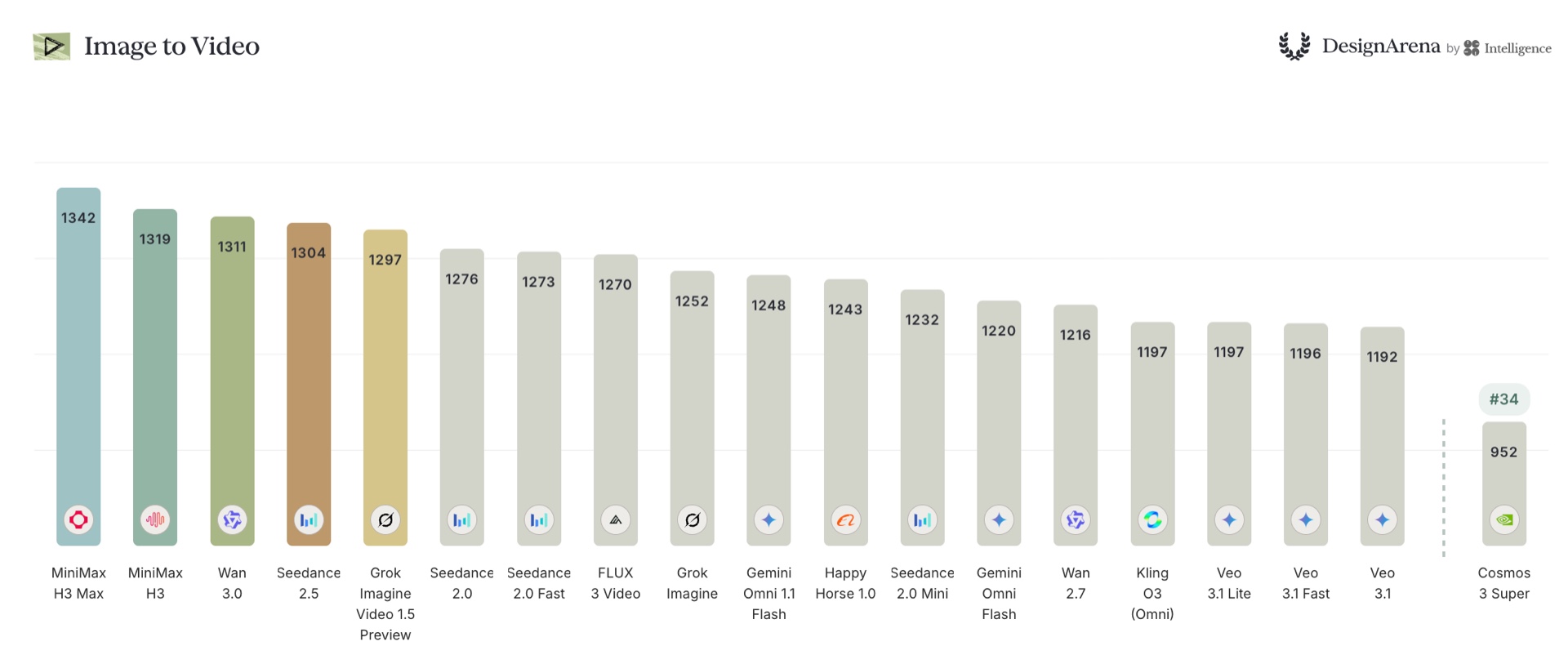
Quality-wise, the model still holds its own near the top of the pack. On the image-to-video leaderboard from Design Arena, H3 Max took first place with an Elo of 1341, edging out base MiniMax H3 at 1333, along with Seedance 2.5, FLUX.3, and Gemini Omni Flash. On the Artificial Analysis leaderboard that factors in audio, it also lands in first with an Elo of 1201 across a sample of 2,177 clips.
The idea of an endless AI broadcast isn't new. Back in 2023, Twitch hosted Nothing, Forever, an endless pseudo-"Seinfeld" with low-poly figures and generated dialogue, which got pulled after a bad joke and later got reworked with nameless characters to dodge rights issues. The difference is that back then only the text was generated, while the visuals stayed static.
Hobbyists are already recreating the setup on home hardware. The open-source project SlopTV on GitHub renders clips on a pair of RTX 5090 cards at 352x608 resolution, then upscales them to 1080x1920, pipelining the next scenes while the current one plays.
Not everyone shares the enthusiasm. Investor Matt Shumer summed up his take in a few words.
Infinite digital fentanyl.
Fal also faces a separate complaint over its closed approach. The base MiniMax H3 launched with open weights, supports clips from 5 to 15 seconds at 24 frames per second, native stereo audio, and output up to 2K. H3 Max, on the other hand, remains a fine-tuned layer fal built on top of those weights, and it hasn't been released publicly so far.
- Promised 30% annual returns and an AI supercomputer for mining – businessman faces 280 years in prison
- Skyrim player launched DLSS 5 with 4000 mods on RTX 4080 Super
- NVIDIA reveals DLSS 5 performance – the model is 5 times faster, but it takes up to 60% of frames