Enthusiast attached a dual-tower CPU cooler to a GTX 1080 Ti and dropped the temperature by 32 degrees

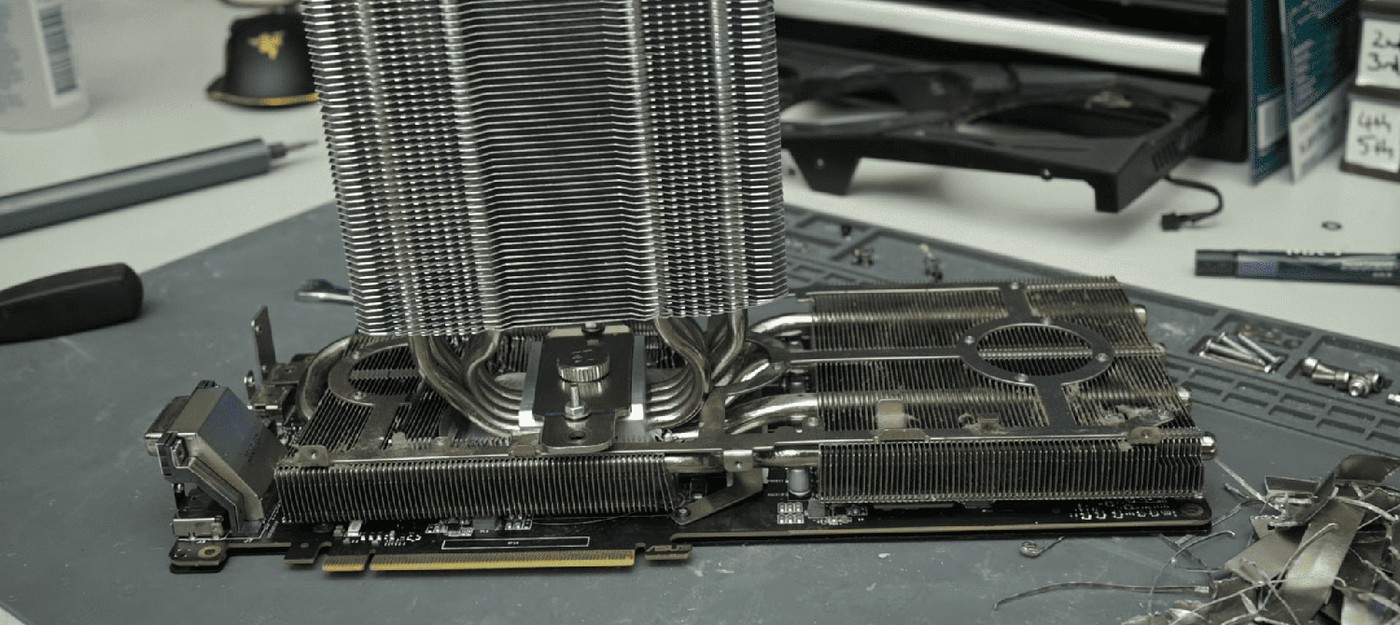
Modder TrashBench is back with another round of experiments on old Nvidia Pascal cards, this time cutting apart three different GPUs: the GTX 1060, GTX 1070, and GTX 1080 Ti. The idea was simple on paper – slice off part of the stock heatsink with an angle grinder and bolt on a full CPU cooler with fans and RGB in its place. The approach worked on all three cards.
The test subject was an Asus Strix GTX 1070, which TrashBench initially mistook for a GTX 1060 since both cards share the exact same cooler. He separated the heatsink from the plastic shroud, then used an angle grinder to cut away part of the finstack. The goal was to expose the back of the metal plate that makes contact with the GPU die.
The first test ran on the GTX 1060 with a plain 120mm fan zip-tied on. Despite missing a chunk of fins, load temperature dropped from 46°C to 45°C. TrashBench then drilled holes into the exposed metal plate and screwed a single-tower CPU cooler directly into it, which brought a 9°C improvement along with slightly higher clocks.
Moving to a dual-tower setup required extra work on the baseplate. Once mounted, temperature dropped by just one more degree, even though two fans and a much larger finstack were now handling the heat. Running the GTX 1060 overclocked in this configuration netted 9% higher FPS in Shadow of the Tomb Raider compared to stock cooling, at 6°C lower temperatures.
The gap widened considerably on the GTX 1070. The dual-tower cooler ran 20°C cooler than the factory setup, while the card also drew 15W less power and held higher clocks. A push for 2,200 MHz wasn't stable, but the system held at 2,177 MHz, good for almost 200 MHz over stock and 7% more frames.
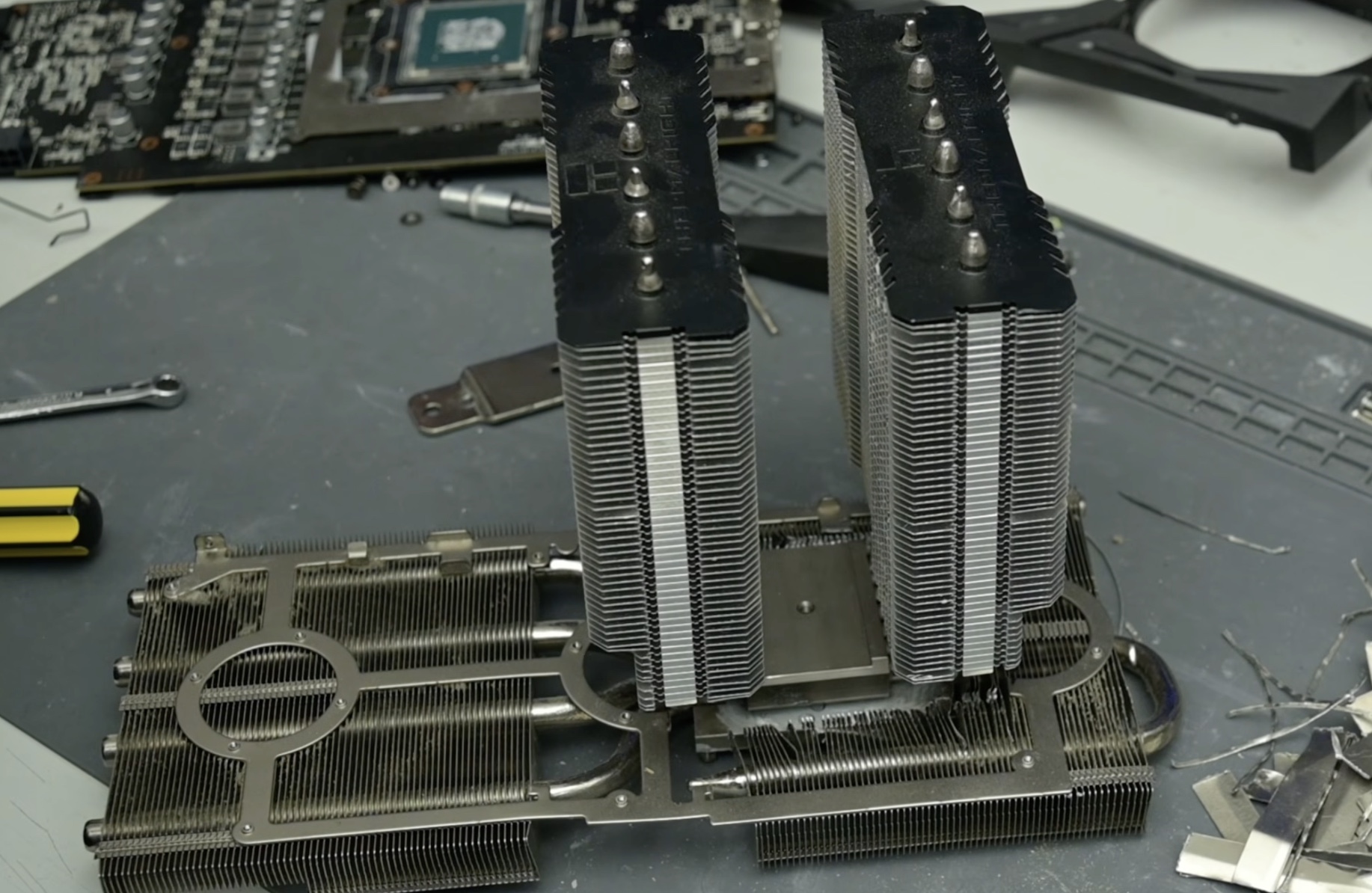
Worth keeping in mind, the GTX 1060 and GTX 1070 ship with identical coolers despite having different TDPs – 120W and 150W respectively. That's exactly why the same mod produces such different results on the two cards. The GTX 1080 Ti sits in a whole different league at 250W and comes with a much beefier stock heatsink.
To keep the comparison fair, TrashBench transplanted a GTX 1060 cooler onto the GTX 1080 Ti first. Even in that configuration, the card ran 8°C hotter under load. Against that baseline, the dual-tower cooler held the same clocks while drawing 30W less power, roughly a 12% cut in consumption.
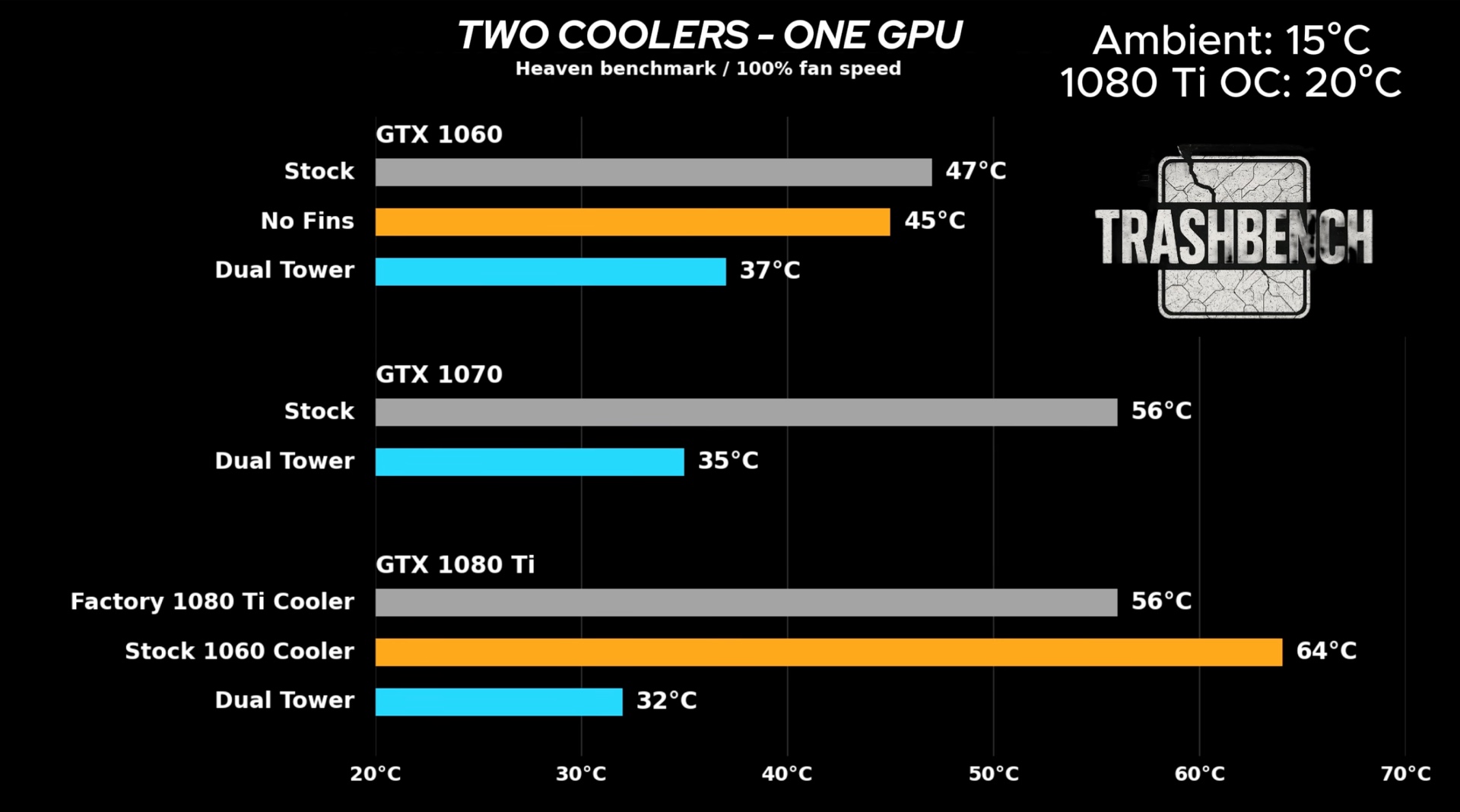
In the first run, the hotspot temperature with the GTX 1060 cooler hit 72°C, while the CPU tower kept things at just 42°C. In the second run, the gap narrowed to 23°C, still a huge margin. Even after overclocking to 2,152 MHz, the modded cooler ran 19°C cooler than stock despite pulling more power at that point.
Mods like this aren't just about chasing lower temperatures. Owners of similar builds point out that tower coolers fit much better into a front-to-back airflow layout, while standard GPU coolers tend to scatter hot air in every direction inside the case.
There's another perk too – a bigger heatsink lets the fans spin at minimal speeds, resulting in a nearly silent system.
- Why you shouldn't keep your PC case on the floor
- RTX 5080 owner burns out graphics card after launching GTA 5 with DLSS 5 – replacement issued anyway
- The Samsara wheel of PC Gamers – new technologies slow down old powerful graphics cards