The Samsara wheel of PC Gamers – new technologies slow down old powerful graphics cards

Upscaling and frame generation were originally created for one purpose – giving weaker hardware a second wind. In practice, the industry quickly found another use for them: instead of optimizing a game for real hardware, a developer just tosses in DLSS, FSR, or Frame Generation and hits the target numbers in benchmarks.
Frames get drawn artificially rather than honestly calculated by the GPU – and from a marketing standpoint, there's no difference.
That idea sparked a meme that recently spread across the PC Master Race community on Reddit. The image showed a typical PC gamer cycle of samsara – buy a new graphics card, enjoy it for a while, then watch performance tank the moment some new technology rolls out.
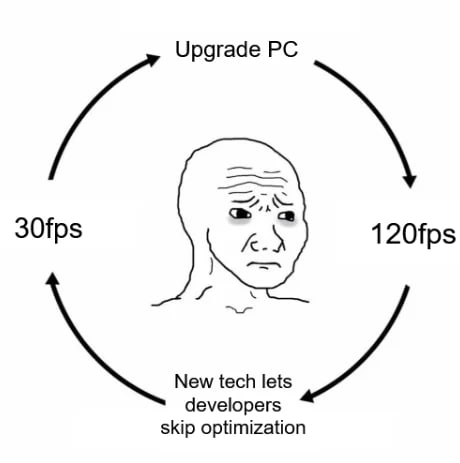
The joke hit a nerve: over the past couple of years, upscaling and frame generation stopped being a bonus for weaker systems and turned into a baseline requirement for running new AAA releases, even on top-end graphics cards.
Nvidia DLSS and AMD FSR originally rendered images at a lower resolution and filled in details using neural networks, saving GPU resources. Frame Generation took things further – it doesn't calculate frames at all, it generates intermediate ones by interpolating between two real frames.
Formally, FPS jumps by a multiple, but input lag and artifacts stay tied to a much lower "real" frame rate, which is why commenters under the post flat out called what's happening fake frames.
The comments also turned up a real-world example of why this keeps happening. One person in the discussion, who said they work as a developer at Amazon, gave an honest look at daily life at a major company:
We barely even review code anymore. Especially with AI and shit. I know for a fact that the system I work on runs the exact same data conversion 3 separate times on a single workflow, and it will probably never be fixed.
According to them, good code practices haven't just vanished from game development – they've disappeared everywhere deadlines and reporting to managers take priority over the quality of the final product.
While some studios lean on neural networks instead of manual optimization, plenty of gamers found their own workaround – the backlog. In the same thread, people shared stories of having multi-terabyte folders full of PS2 games, indie title collections, and old SNES JRPGs that run on any modern PC at hundreds of frames per second without a single upscaling artifact.
- Replacing thermal paste boosted FPS on RTX 2080 Ti almost twofold and lowered hotspot temperature by 10 degrees
- The artist showed a 23-year-old photo with the fairy that Nvidia once used to promote video cards
- Enthusiast attached a dual-tower CPU cooler to a GTX 1080 Ti and dropped the temperature by 32 degrees