Half of paid games on Steam earned less than $3,600, while the top 1% of the most successful releases brought in 85% of the revenue


A new analysis of 99,206 paid games on Steam shows just how polarized the economics of Valve's platform have become. Half the catalogue has earned less than $3,622 over its entire lifetime, while the top tier pulls in anywhere from $15 million to several billion dollars. The gap between these two extremes isn't measured in multiples anymore – it's closer to astronomical.
The research comes with the usual caveat attached to any Steam analytics. Valve doesn't publish revenue figures, so the numbers here get reverse-engineered from user review counts multiplied against a game's current price.
The sample leaves out free-to-play giants like Valve's own Counter-Strike, along with non-game software and titles flagged as adults-only. The final set of 99,206 games was pulled from a larger pool of 136,281 – meaning this covers premium, paid games exclusively.
The report's baseline multiplier sits at 35, meaning each review is treated as roughly 35 sales. The interactive charts let you switch to a more "conservative" 20 or a "generous" 50 instead. That ratio isn't fixed in reality, and games almost always sell better during sales – unless you happen to be Factorio, which famously refuses to discount.
Even with soft estimates, the broader trends hold up, and several figures line up with publisher financial reports and other analysts' work. The margin of error matters most at the top, where a single percentage point can swing tens of millions of dollars. For the bottom 90% of the catalogue, the picture is far more stable.
Half of all paid games on Steam have earned less than an estimated $3,622 in their entire lifetime. A game at the 90th percentile has earned about $236,184, and the 99th percentile starts at $15,872,031.
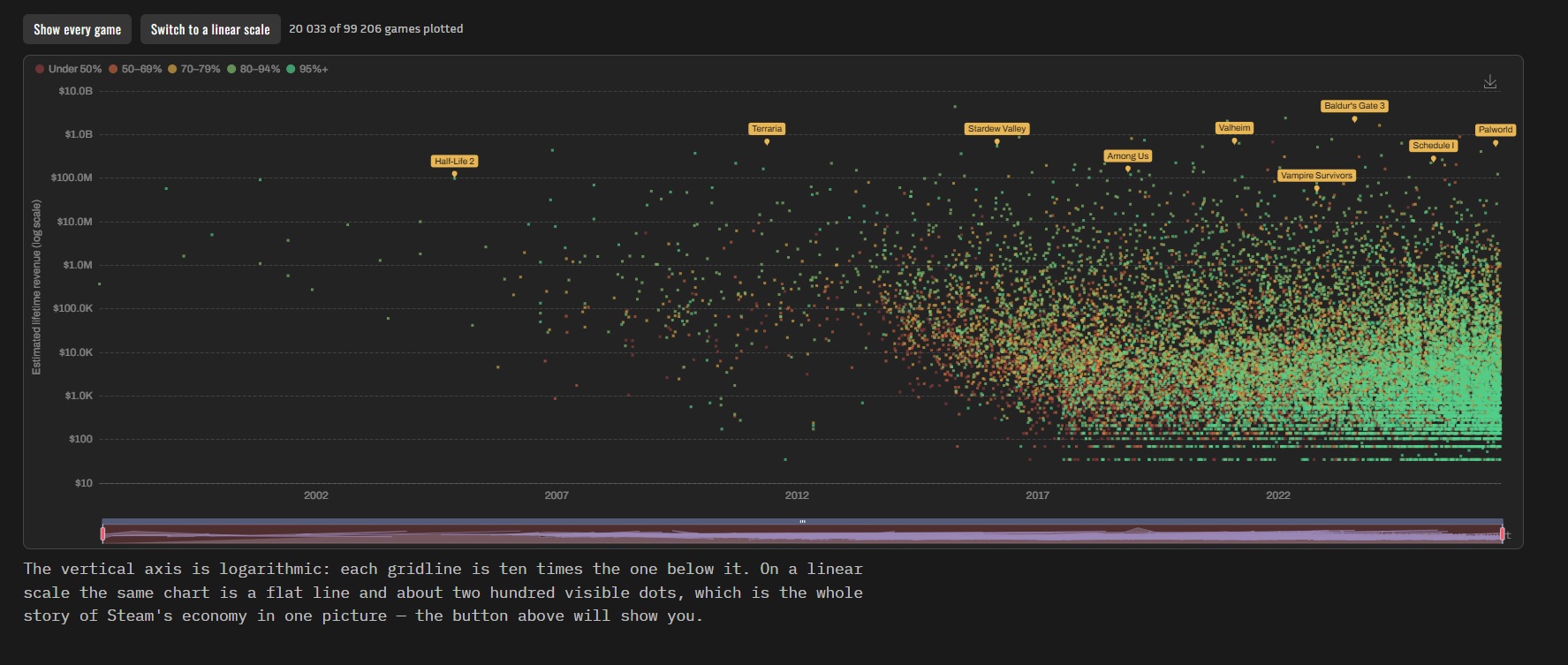
A scatter plot turns these numbers into something visual: a dense green storm near the bottom and a scattering of hit games up top. Above the $100 million mark sit Half-Life 2, Vampire Survivors, Terraria, Among Us, Stardew Valley, Valheim, Schedule 1, Palworld, and Baldur's Gate 3. Right at the very top is GTA 5.
On a linear scale the same chart is a flat line and about two hundred visible dots, which is the whole story of Steam's economy in one picture.
The genre breakdown is just as interesting. Sandbox games have surged in popularity over the past few years and now look like the platform's most reliable genre. In 2026, sandbox also leads in "crowding vs. payoff," outperforming much larger genres on revenue per game.
3D and 2D platformers came out as the worst-performing genres in the study. Data tracking when each genre peaked suggests things have only gotten tougher for them in recent years. Action and adventure remain so broad and popular that they've stayed on top for years, but simulation and strategy games are visibly closing the gap in terms of new releases.
The genre math stays fairly approximate because of how it's tracked. A game only counts toward a genre if that tag ranks among its six most popular tags on its store page. A hit like Hollow Knight: Silksong could end up sorted under vaguer categories like "exploration" or "action" instead of 2D platformers, since it has no "metroidvania" tag at all.
- Valve requires old CD key from Half-Life 2 to return the player's old account
- Steam brought Valve $15 billion in 2026, with Crimson Desert alone earning $203 million
- Valve saved the current build of Half-Life: Alyx to a separate branch, and the community is already building theories