PewDiePie released an uncensored AI model for home PCs and got banned by OpenAI for distillation


Felix Kjellberg, known as PewDiePie, unveiled Ajax – a custom language model that runs locally on a home computer.
According to Kjellberg, OpenAI banned his account twice during development, and one of the emails shown in the video cites "distillation" as the reason.
Ajax is built on Alibaba open Qwen3.5-9B model, which has 9 billion parameters, and Kjellberg fine-tuned it for his own needs. It runs inside Odysseus – an open AI workspace he launched in May – and works as an always-on assistant agent. Ajax can search for information, browse websites, and handle email, calendar, and notes. It runs on consumer graphics cards or Mac computers.
The name is no accident – in Greek mythology, Ajax was a rival of Odysseus. Kjellberg joked that the model is actually named after the cleaning product.
The main selling point of Ajax is the lack of the usual restrictions. To remove refusals on "uncomfortable" requests, Kjellberg used Heretic, an open-source tool that automatically finds and strips out refusal mechanisms from a model. The method is called ablation. On the advice of a lawyer, he also noted that the model is not meant to hand out dangerous practical instructions, and he drew his own line at causing harm to others or to oneself.
The biggest reaction came from the ban saga. Distillation is a training method where a small model learns from the outputs of a larger, more powerful one, picking up some of its abilities. OpenAI considers the technique legitimate, but its terms of use prohibit using the service outputs to build competing models and automatically pulling them out in bulk.
Kjellberg said he wanted to "distill just a tiny bit" to improve his model. He used the reasoning of an OpenAI model called Sol to prepare training data.
The first ban came with a direct mention of distillation. Access was restored after an appeal, but when he ran the model again to generate the initial training data, a second ban followed. Kjellberg was baffled by how OpenAI found out at all.
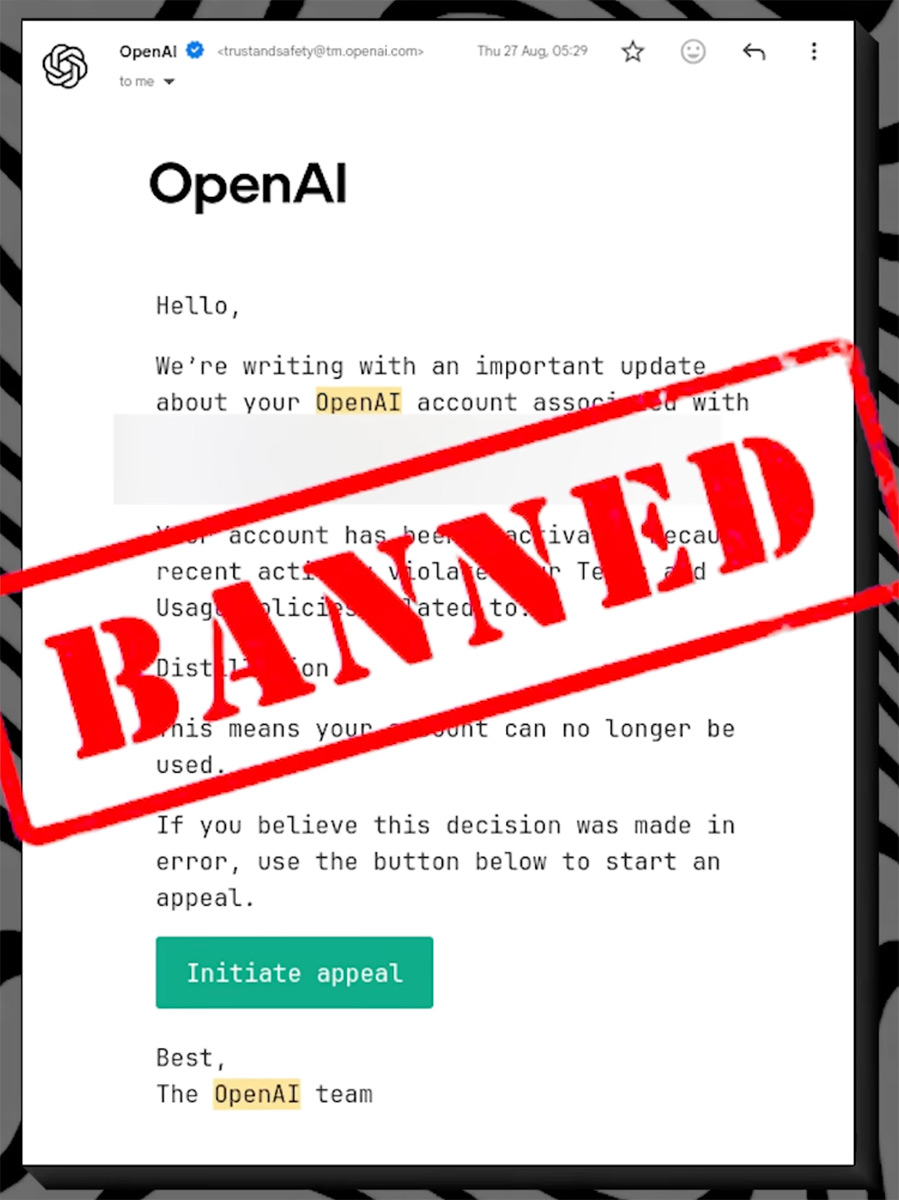
OpenAI has not commented publicly, so all the details come from Kjellberg himself and from the email shown in the video.
Much about the model remains unclear:
Ajax has no final model card describing its specs
no benchmark results have been published
the license for the model weights is unconfirmed
the weights are not publicly available yet, and the download link leads to a training data collection page
Early tests show Ajax handles roughly 90% of tasks successfully, though Kjellberg calls the project unfinished. Before the next version, he plans to quantize the model so it takes up less memory and run full testing. Odysseus, he says, has also received a major update.
There was some absurdity, too. About a minute after the video went live, a memecoin called $Ajax appeared on the Solana network, with no established connection to Kjellberg.
The PewDiePie story landed in the middle of a heated industry debate over distillation. A few days before the release, Nvidia CEO Jensen Huang declined to call distillation theft on CNBC, even though US Treasury Secretary Scott Bessent used that exact word back in July and threatened sanctions against foreign companies.
It's called competition.
According to Huang, companies that dislike this kind of use of their products just need to know their customers and cut off service. OpenAI apparently did exactly that – on September 30, it said it had shut down a campaign linked to people close to China-based Moonshot AI, who were trying to extract its protected reasoning at scale, and called it hostile distillation.
- 85-year-old enigma cipher cracked by AI in two days – ChatGPT-6 Astra wrote its own simulator to break it
- OpenAI believes AI can link two isolated computers via processor heating instead of Morse code
- Gamer set GPT-6 Astra to play through Fallout 3 – the AI reached the ending in 59 hours and started paranoidally checking saves