Simulation of a billion atoms showed that tungsten in fusion reactors degrades faster than predicted

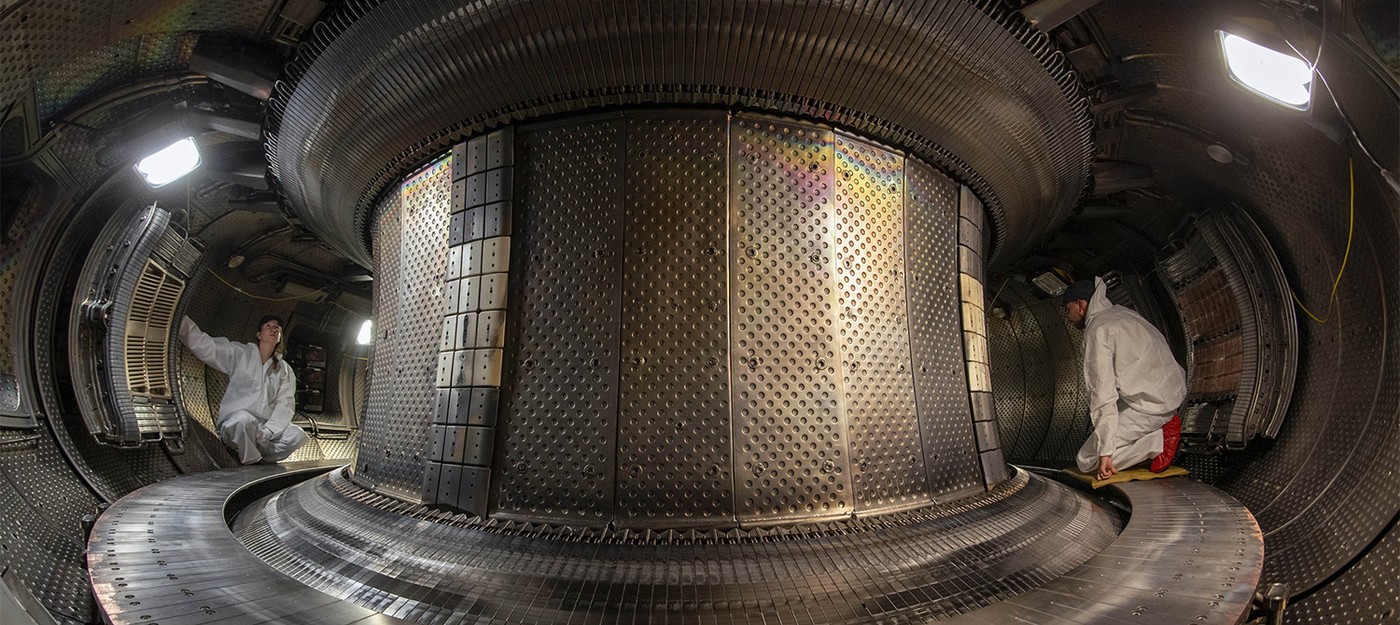
Physicists at the University of Helsinki ran large-scale numerical simulations and found that tungsten, the leading candidate for the plasma-facing wall of tokamak fusion reactors, degrades under neutron radiation considerably more than earlier calculations suggested.
Nuclear fusion releases energy when two light nuclei combine, and triggering the reaction requires enormous temperatures and pressures, conditions comparable to what's found inside stars. Materials sitting near such a reaction endure stresses unlike anything in conventional engineering.
Tungsten was chosen for its exceptional resistance to extreme heat, it has the highest melting point of any metal. But the new research shows that thermal resilience doesn't solve the other problem: radiation damage to the crystal lattice.
Jesper Byggmästar, a physicist at the University of Helsinki, explained the approach to Phys.org:
"Our recent paper focuses on the primary radiation damage, that is, the damage created by a single atomic recoil. Understanding this is an active field of research."
Here's how the destruction plays out: fusion reactions eject high-energy neutrons that slam into the atoms of a structural material and knock them out of their lattice positions. The displaced atom then becomes a projectile itself, setting off a chain of collisions known as a displacement cascade that reshapes the structure of the entire section.
The tricky part is that this process isn't just a simple buildup of defects. Some displaced atoms drift back to their original spots, cascades partially recombine, and the final damage depends heavily on the size of the region being modeled.
That's why the team set out to reproduce the chaos of irradiation as fully as possible. The calculations drew on well-established molecular dynamics of materials under stress, and the researchers exposed tungsten to different energy levels it would experience in a reactor before, during, and after a reaction.
In the end, the team simulated up to a billion atoms at once, cross-checking results against existing models to confirm they were accurately capturing real-world dynamics. That scale revealed effects that smaller simulations tend to miss.
During reactor operation and in irradiation experiments, the material is subjected to much more irradiation over longer time and length scales.
As exposure duration and area increased, tungsten degraded faster than expected. That doesn't rule the metal out for fusion power, but it does change how engineers need to calculate component lifespans.
ITER, the international experimental reactor, already plans to use tungsten in its divertor, the component that absorbs the most intense flow of particles and heat from the plasma. Byggmästar added that the findings will likely prove more useful for designing sturdier, longer-lasting components overall than for abandoning the material altogether.