Japanese 3D artist used two AI models to create a room in Unreal Engine 5 without ever opening Blender

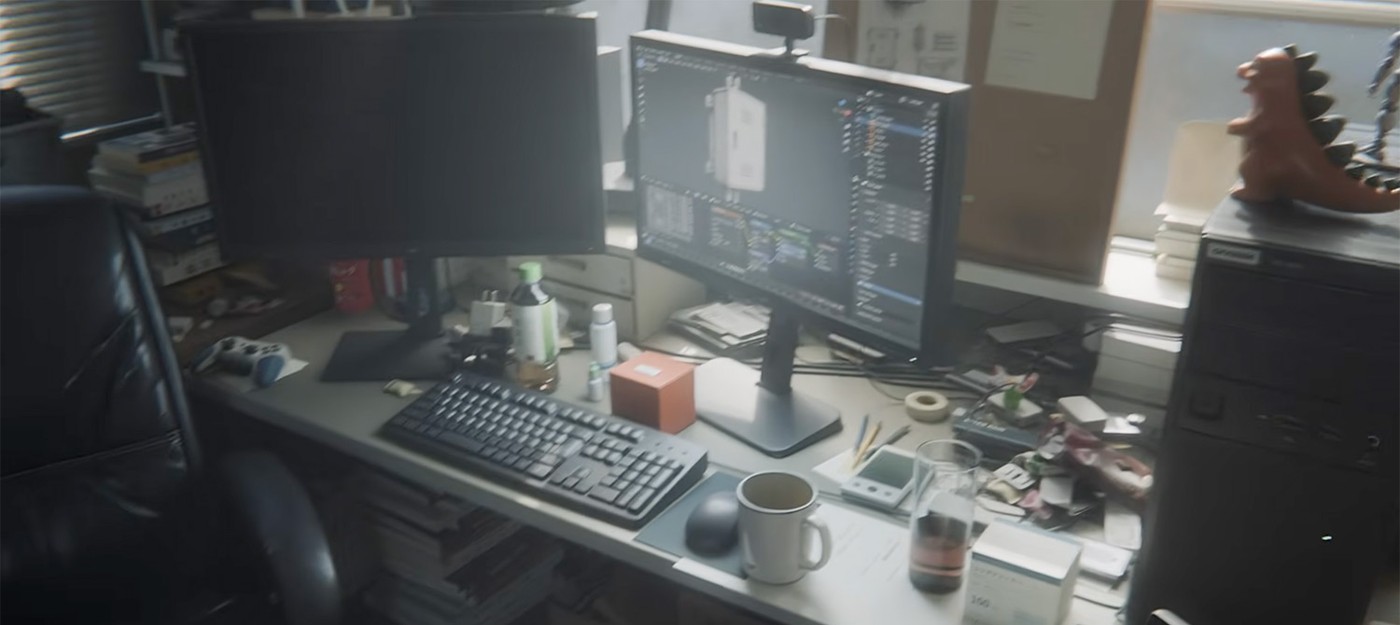
Japanese 3D artist Hirokazu Yokohara showed off a detailed interior scene built entirely by AI.
OpenAI GPT-6 Astra and Anthropic Claude Opus assembled the scene in Blender, and then Opus moved it into Unreal Engine 5 on its own. The artist never touched a single Blender tool himself, only giving directions and feedback along the way.
Yokohara is known as a CG director, art director, and environment artist. He previously showed a semi-realistic virtual avatar in Unreal Engine 5.3 with path tracing, along with real-time simulations of fur, fire, and smoke. In recent months, he has been experimenting more and more with generative tools, from generating 3D models with clean quad topology to real-time image generation right in the Blender viewport.
A video about how the scene was made appeared on Yokohara's YouTube channel – the artist explained that he cut manual work in the editor out entirely:
Test of creating Blender scenes using only AI without ever touching Blender myself - daytime version.
Changes to daytime lighting and compositing are also left entirely to AI.
The handling of lighting and fog is far better compared to before
The work went through several stages. Some of the interior details were finished over a weekend using nothing but a smartphone:
The detailing on the opposite side of the room and the daytime lighting were done while messing around on a day off using just my smartphone, and aside from the small screen size, there were no particular issues.
With voice input available, keyboards are starting to feel less essential too.
On October 13, the artist announced his next task: converting the scene to Unreal Engine. Three days later, he published a real-time version of the interior and explained how the transfer went:
Real-time version of an indoor scene made solely with AI.
Used Opus to automatically port it from Blender to UE5.
Bringing it into the game engine was insanely tough, but using AI made it ridiculously convenient.
Maybe I'll try making a small horror game using this room
The result sparked arguments on social media about where it came from. Some viewers thought the scene was handmade, while others decided they were looking at an AI-generated video. Yokohara commented:
Is it handmade? Is it video generation? It's funny that people are debating this while watching it.
The important thing is that when AI agents directly model, generate original designs, do 3D generation, and automate across various tools, people can create something like this.
DCC (Digital Content Creation) is a general term for professional software used to create digital content, such as Blender, Maya, or Cinema 4D. Learning these packages usually takes many months of practice, while AI agents let users bypass that barrier.
The experiments didn't stop there – the other day, the artist showed an endless looping room in Unreal Engine 5. According to him, during testing he told the AI to build such spaces while he slept.
Yokohara's work continues the wave of demos that began after GPT-6 Astra launched on September 3. OpenAI initially pitched the model as strong at 3D modeling and controlling game engines.