Chinese engineers built a centaur robot that straps to your back and walks behind you on two legs

Robotic exoskeletons and load-bearing devices are nothing new – from futuristic frames that let you climb stairs without breaking a sweat to industrial wrist braces for overhead factory work. But a team of engineers from Shenzhen took a dramatically different approach, drawing inspiration from Greek mythology: the centaur, half horse, half human.
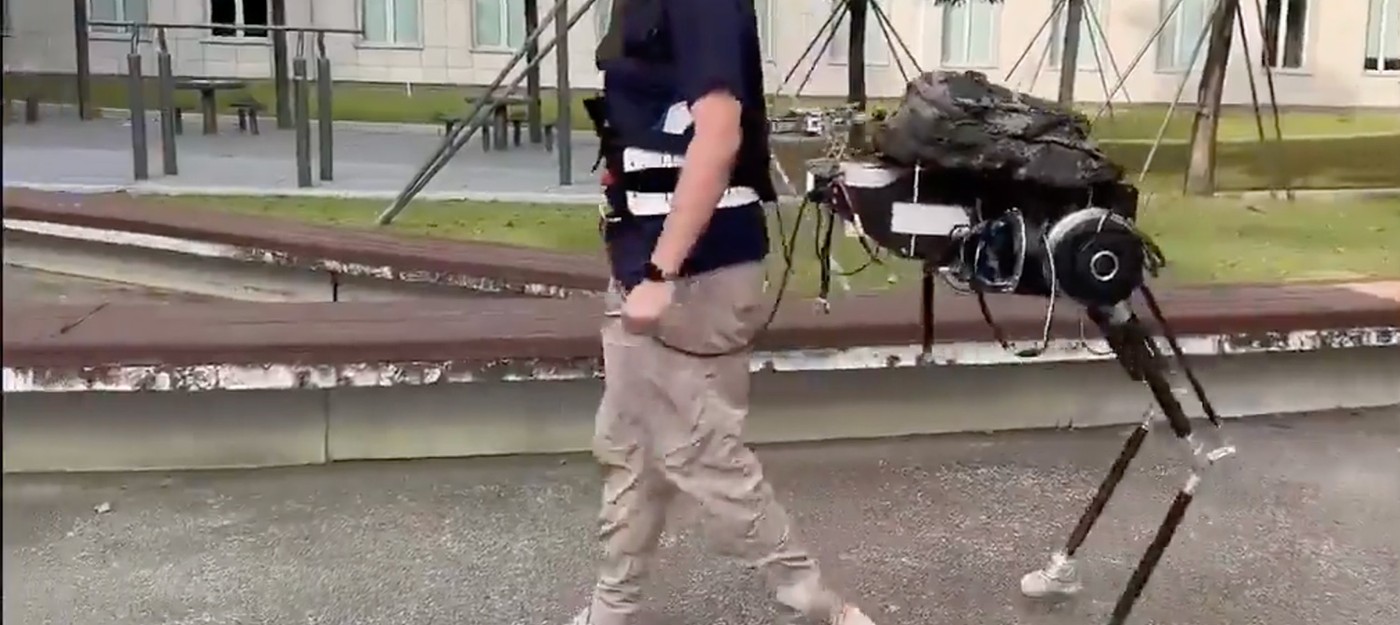
In video demonstrations released alongside a paper published in the International Journal of Robotics Research, an engineer walks around a university campus while a two-legged robotic "centaur rear" strides along behind him. The contraption attaches to the wearer from the back and follows along, adapting to their speed and direction.
On flat ground, the robot's spindly legs seem to struggle keeping pace with the human up front. But the moment the wearer hits a staircase, the advantage over something like a pair of wheels becomes immediately clear.
"Experimental evaluation results demonstrate that the Centaur robot effectively adapts to varying human walking directions and speeds while seamlessly collaborating with the human to traverse diverse terrains," the researchers from the Southern University of Science and Technology wrote.
The team found the system cuts "metabolic cost" substantially compared to carrying a regular backpack of similar weight – around 44 pounds. The robot redistributes the load, taking pressure off the wearer's body. It can even generate a horizontal force, effectively giving the person a push forward while walking.
The researchers argue that while autonomous robots like robodogs are "being actively explored as load-transport solutions without direct human involvement," they come with real limitations – unreliable navigation in unmapped environments, limited payload capacity, and heavy battery drain. The centaur approach sidesteps those issues by letting the human handle navigation entirely.
Not everyone was impressed. Reddit's armchair engineers had a field day. "I feel like a shopping cart would almost always be a better solution," one user wrote. Others questioned the safety of stumbling while strapped to a walking load-bearing machine, and at least one person wanted to know if the researchers had ever heard of a rickshaw.