Some crazy Besiege engineer built a realistic diesel-electric submarine in the medieval sandbox

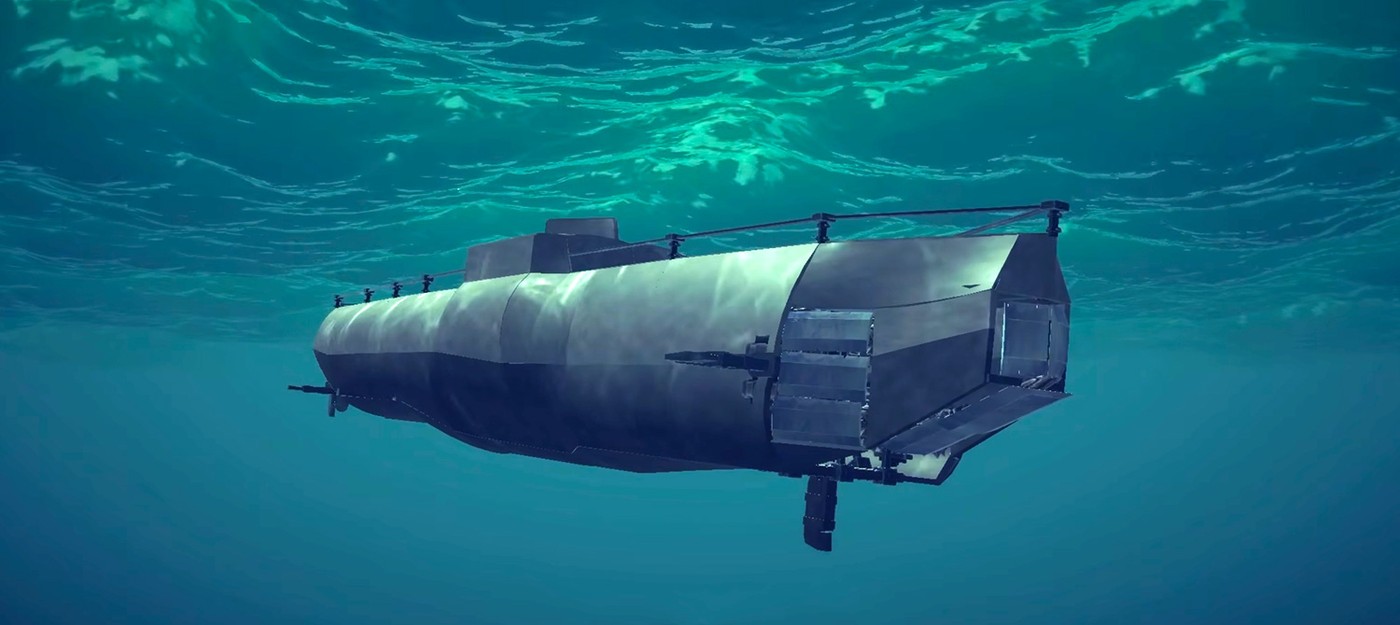
YouTuber Silexion built a fully functional diesel-electric submarine in Besiege – a medieval siege machine sandbox – complete with a working engine, battery system, flywheel-powered torpedoes, and depth control. The video caught enough attention that Spiderling Studios shared it on their own social media.
The centerpiece of the build is an accurate simulation of a diesel-electric drivetrain. Real pre-nuclear submarines ran on diesel engines that produced toxic fumes, meaning they could only run on the surface – underwater, the boat switched to battery power. Since electricity doesn't exist in Besiege, Silexion had to get creative.
The engine uses a boxer configuration that balances the forces from the pistons, with length sensors handling timing instead of the clunky asymmetric wheel from the previous version. Crucially, it drops the brace blocks entirely – those have a hard cap on angular velocity that was killing power output in the old design.
The battery stores potential energy as rope length. All powered blocks in Besiege technically have infinite energy, but rope blocks only produce usable motion when their nodes are pulled apart, which makes rope length a natural stand-in for battery charge. A chain-and-sprocket system converts that linear motion into rotation, and the engine can spin the sprockets in reverse to recharge it.
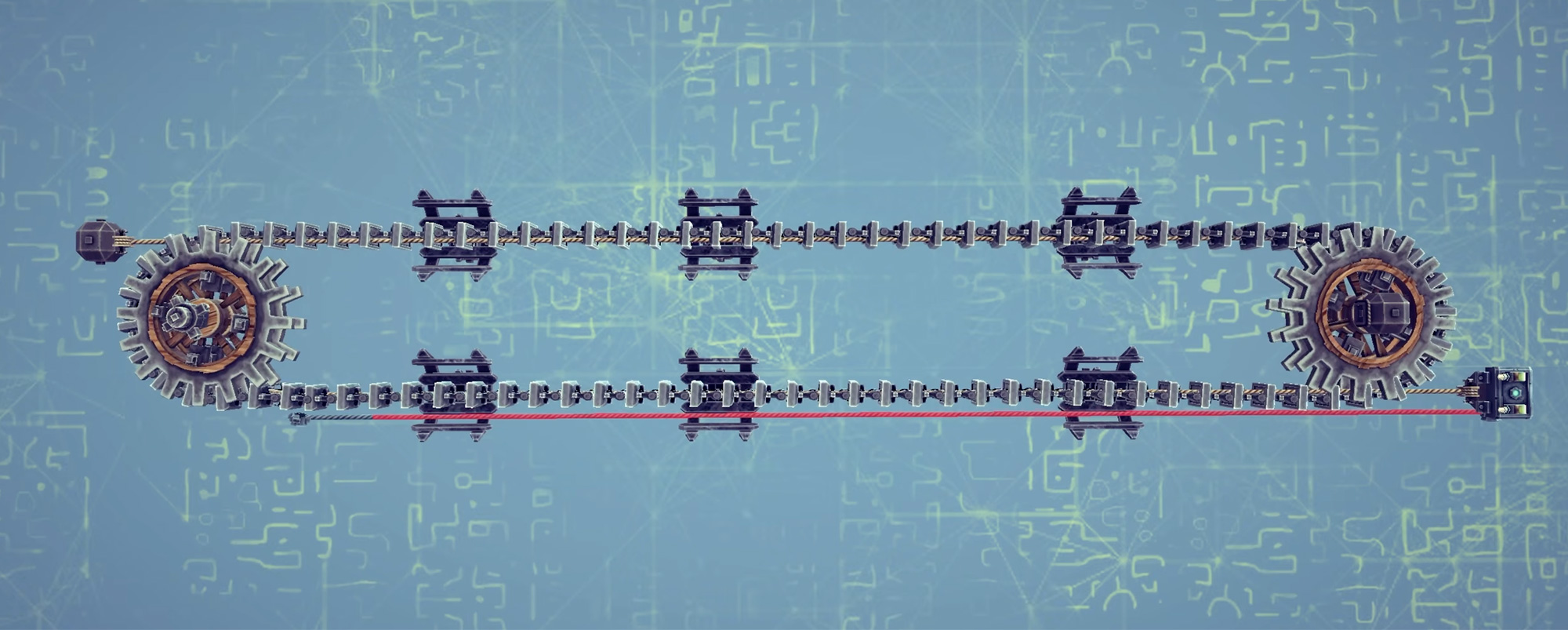
The motor is built around a differential – three interacting blocks where one rotation at the input produces four at the output. No gears, no braces, just a compact and durable overdrive that outperforms the old design in every way.
All the linkages use flywheel blocks as clutches that can lock and unlock on command. On the surface, the engine drives the screws directly. When submerged, the battery discharges through the motor. Once depleted, the sub surfaces and the engine simultaneously drives the screws and recharges the battery through a chain of reductions – effectively turning the motor into a generator.
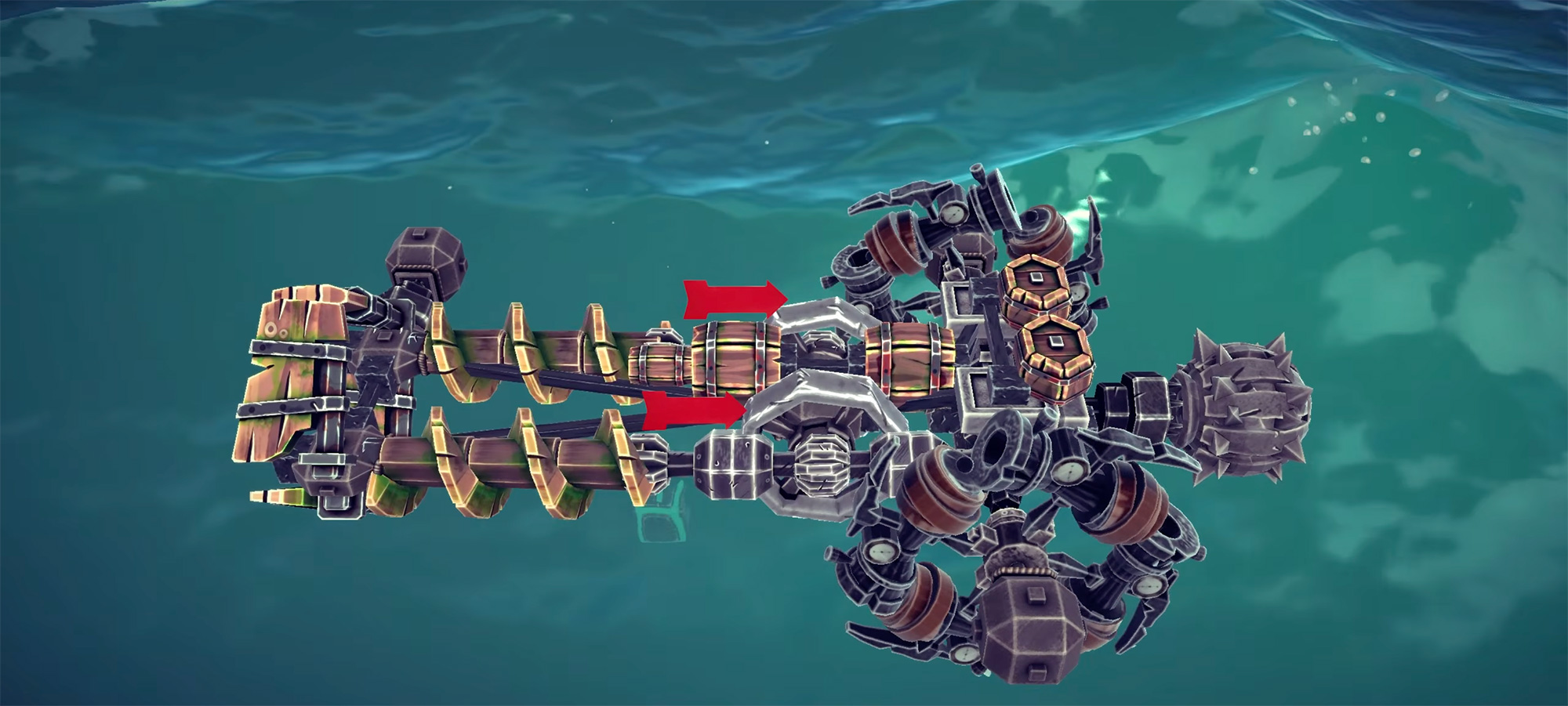
The torpedoes are based on the real Howell torpedo, the first self-propelled torpedo produced in quantity by the US Navy in 1870, which used a heavy flywheel spun up by a steam engine before launch for both propulsion and gyroscopic stability. Silexion initially used two counter-rotating flywheels to cancel out torque, but eventually landed on a cleaner solution: a sacrificial wheel placed in front that absorbs all the torque before it can twist the body. The result is a more streamlined, faster torpedo.
The finished submarine carries six flywheel torpedoes up front, barrels for buoyancy, a depth control system, a wooden hull for aesthetics, and opening torpedo tube hatches. Silexion says the new boat is faster and more maneuverable than his previous design, both on the surface and underwater.
One weakness: the hull is made of wooden surface blocks, which makes it pretty sensitive to depth charges. Thanks to water being incompressible in Besiege physics, shockwaves damage the hull even without a direct hit.
Silexion also mentioned that since his last video, he graduated college and landed a job as an actual engineer.
Meanwhile, Besiege is getting a space expansion.