An artist built a website that predicts the apocalypse based on billionaire private jet activity


Tracking the private jets of the rich and powerful has long been a hobby for enthusiasts – despite every effort by aircraft owners to prevent it. Now artist and developer Kyle McDonald has found a genuinely unexpected use for that data: predicting the end of the world.
The logic behind Apocalypse Early Warning, McDonald's site, rests on two simple premises:
First, if nuclear apocalypse is imminent, the wealthy and powerful will find out before everyone else.
Second, once they do, they'll almost certainly jump on their jets and fly as far from major cities as possible.
The site puts this idea into practice using public FAA registration data to track a fixed group of business jets – around 11,000 aircraft at launch.
That data is cross-referenced with ADS-B Exchange, which provides real-time flight information.
ADS-B stands for "Automatic Dependent Surveillance-Broadcast" – a system where aircraft continuously transmit their location, heading, and other parameters.
It lets air traffic controllers track aircraft positions and helps pilots know what's nearby. The system is used worldwide, and in the US the FAA has made it a cornerstone of its next-generation air transportation system, calling it the "preferred surveillance method for air traffic control."
The whole point of ADS-B is that the transmitted data is publicly accessible – though Congress is currently considering a bill that would "establish requirements and limitations on the use of ADS-B data."
That bill, however, focuses on using the data to calculate landing fees and airport charges. "Estimating the probability of the apocalypse" clearly falls outside its scope – good news for McDonald.
So how exactly does Apocalypse Early Warning use ADS-B Exchange data? The concept is straightforward: the site tracks how many aircraft from its database are airborne at any given moment and checks whether that number exceeds normal levels.
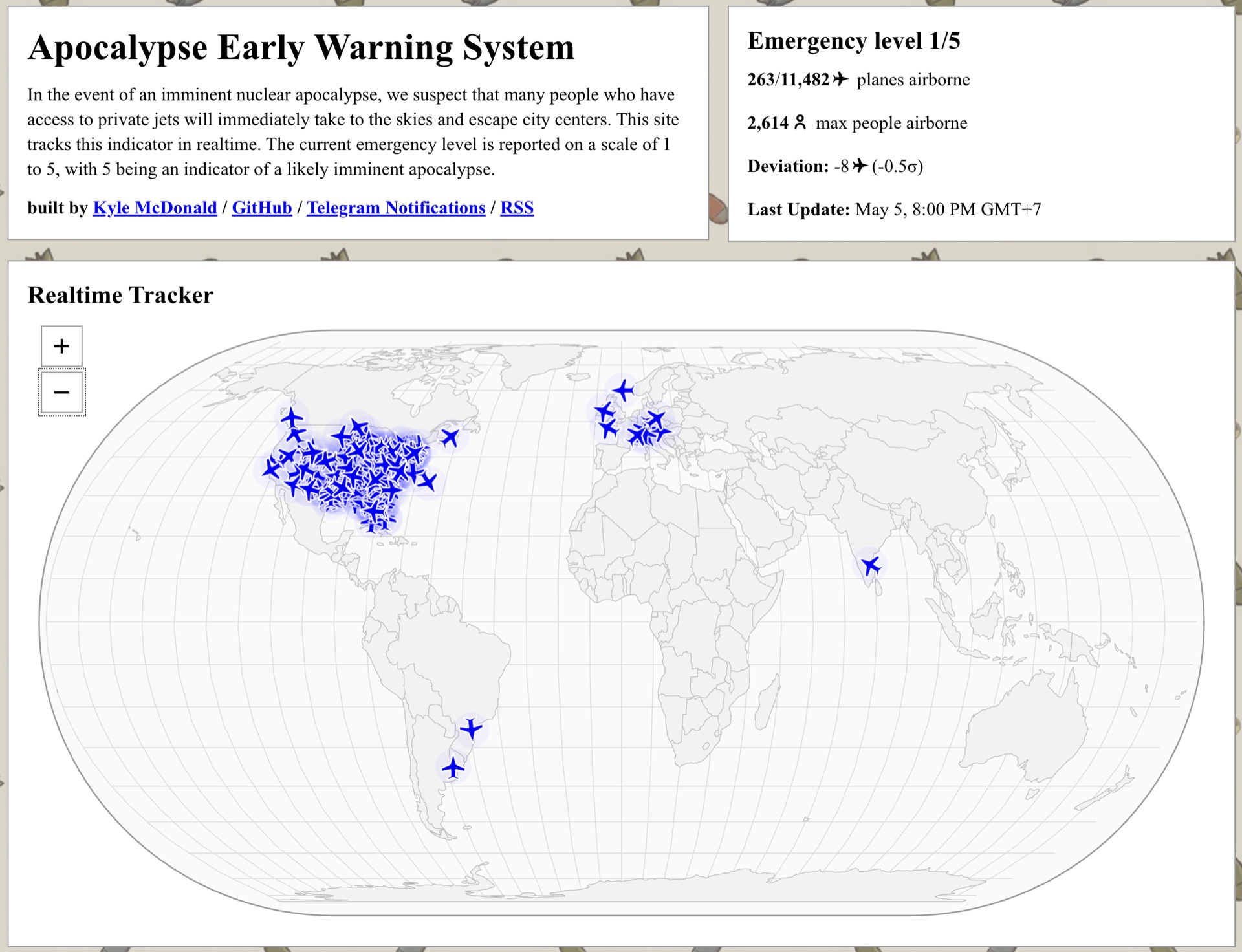
To answer that, the current count is compared against a "recent baseline for the same time of day and day of the week" using historical ADS-B Exchange data.
The difference between the number of planes in the air and the baseline is measured in standard deviations, giving a simple numeric picture of just how unusual current traffic levels are.
That figure is displayed at the top of the site as the "Alert Level." Five standard deviations or more – level 5+ – is flagged as "an indicator of likely imminent apocalypse."
Which raises an obvious question: what are you supposed to do with this information? If you trust McDonald's logic, seeing a "5" at the top of the page means it's time to head for the hills.