Nvidia gaming GPU revenue dropped 13% despite record $215.9B in annual earnings


Nvidia has published its financial results for fiscal Q4 2026, and the numbers tell a complicated story. On one hand, the company continues to pull in staggering sums of money. On the other, gaming GPU revenue fell 13% over the last three months compared to the previous quarter.
There are two clear reasons for the decline, and neither is particularly mysterious. The first is one Nvidia acknowledges in its official report – the prior quarter included the holiday season, when consumer spending hits its annual peak. As Nvidia put it:
"Channel inventory naturally moderated following a season of strong holiday demand."
In other words, the post-holiday slowdown is entirely expected.
The second reason is more damaging for the market. Graphics card prices jumped sharply at the start of the year due to rising VRAM costs, and many buyers simply refused to pay. The result was weak sales and subsequent price corrections that only made the quarterly numbers look worse.
Zooming out, Nvidia gaming still looks healthy. The company brought in $3.7 billion from gaming products this quarter, up 47% year-over-year – growth Nvidia attributes to "strong Blackwell demand," meaning RTX 5000-series chips. Full-year gaming revenue hit a record $16.0 billion, a 41% increase over the prior year. That figure covers desktop GPUs, laptop graphics chips, and the GeForce Now streaming service.
For context, AMD gaming revenue for the same period came in at $843 million – more than four times less than Nvidia. AMD did post 50% year-over-year growth, but the company itself notes that much of that came from semi-custom chips, including processors for Steam Deck and other gaming handhelds, rather than discrete Radeon cards.
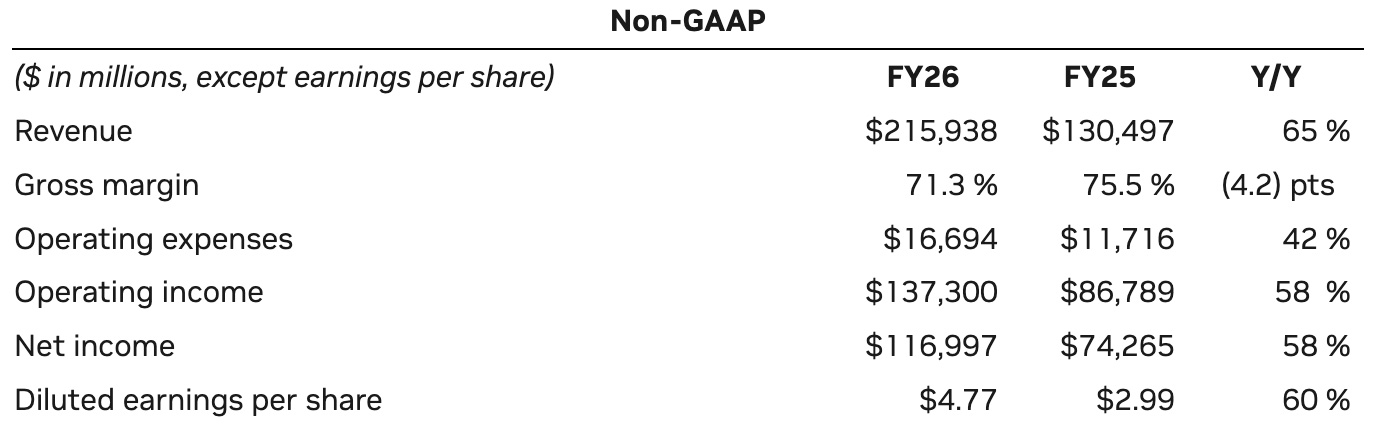
The real money for Nvidia is elsewhere. Data center and AI chip revenue hit a record $62.3 billion in a single quarter – up 22% from the previous quarter and 75% from a year ago. Of Nvidia's total annual revenue of $215.9 billion, an extraordinary $193.7 billion came from that segment alone. Gaming, by comparison, looks almost like a rounding error.
What does any of this mean for the average GPU buyer? Nothing particularly encouraging.
Nvidia is making so much from AI chips that there's little financial pressure to keep consumer GPU prices in check. The hope that data center profits might eventually subsidize gaming hardware remains exactly that – a hope.