Valve's rejection letter to a high schooler becomes a masterclass in human decency


The job market can be brutal. Mountains of resumes go unanswered, candidates pass through multiple interviews only to be met with complete silence. So when Liem Nguyen sent his resume to Valve back in 2015, he wasn't holding his breath.
At the time, Nguyen had just graduated from high school. A tough living situation pushed him to search for any way to make money. He knew he wanted to make games and saw no harm in putting his name out there. Nguyen tried reaching out to every recruiter he could find, but nothing was panning out. Valve, meanwhile, is behind the most popular PC storefront and some of the most popular games in the world. Nguyen wasn't expecting to hear anything back.
But he did. Valve sent a rejection letter – no surprise there. What Nguyen didn't anticipate, though, was an actual human being at the company taking the time to write a detailed explanation. Nguyen recently shared a picture of the email on social media. In it, a worker at the Seattle-based company explained the reasoning behind the rejection and offered some words of advice.
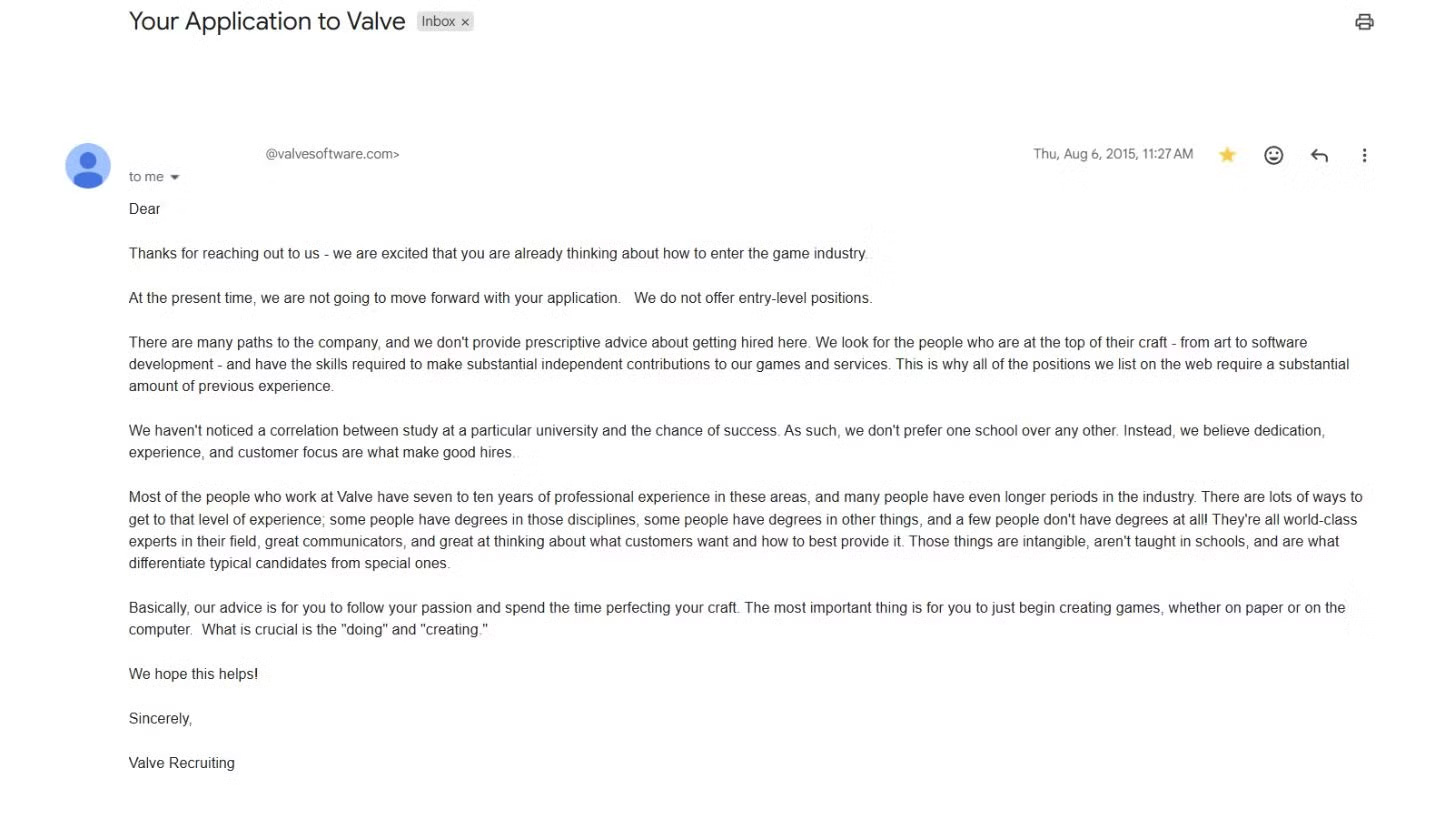
For Valve fans, the letter's contents probably won't come as a revelation. Per employee, the company earns even more than Google and Amazon, raking in around $50M per person. An organization like that doesn't hire newbies and has virtually no entry-level positions. Beyond its services and games, Valve is known for its unconventional workplace approach – a flat hierarchy with no managers or assigned projects. Like other tech companies, Valve doesn't fixate on formal education. Portal began as a student project, and two of the company's most successful games originated as mods. With that track record, the company is destined to receive applications from ambitious teenagers.
Though Valve declined the application, the response went viral on social media thanks to its encouraging tone. In the letter, the company acknowledges it seeks experienced talent, but talent, in Valve's eyes, isn't defined by a degree or title.
Instead, we believe dedication, experience, and customer focus are what make good hires ... Those things are intangible, aren't taught in schools, and are what differentiate typical candidates from special ones.
Basically, our advice is for you to follow your passion and spend the time perfecting your craft. The most important thing is for you to just begin creating games, whether on paper or on the computer. What is crucial is the 'doing' and 'creating.'
Ten years later, Nguyen has taken those words to heart. He's now at an indie studio he funded himself and is working on a new game with biological themes. He looks back on that rejection letter with both pride and some embarrassment. A decade ago, he couldn't truly appreciate the significance of the response – to Nguyen, it was just another rejection among many.
- Gamers crashed Wardogs servers on the very first day of early access – developers partially blame Valve
- Valve requires old CD key from Half-Life 2 to return the player's old account
- Steam brought Valve $15 billion in 2026, with Crimson Desert alone earning $203 million